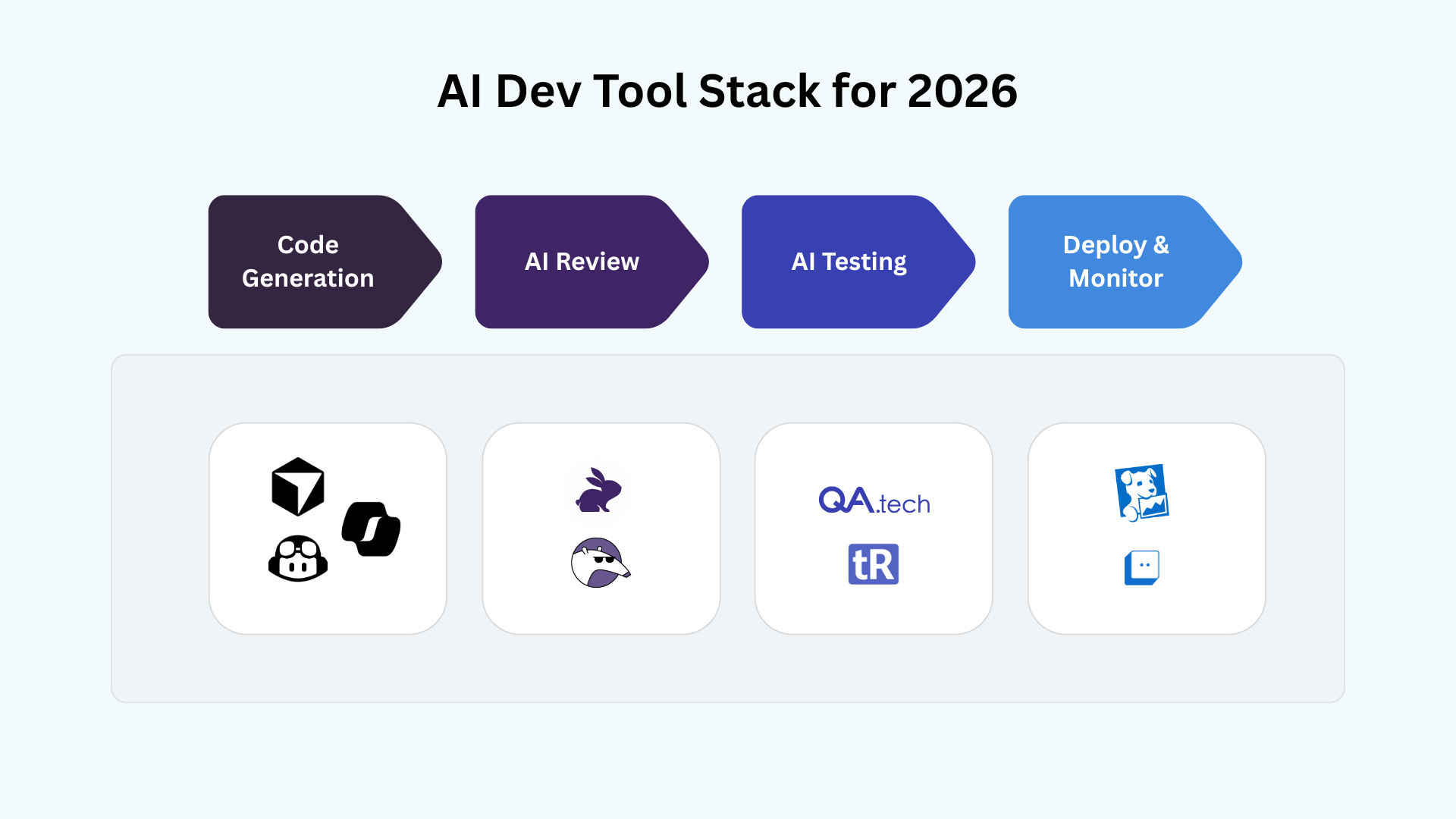
The 2026 AI development tool stack has four layers: code generation, code review, AI testing and QA, and observability. Three of the four are well served. The one most teams have not solved is testing.
Faster code generation does not mean faster shipping. Cursor and Copilot will write the code quickly. Whether it works when a user touches it is a separate question, and more code written means more places for a bug to hide. That verification step is where the pipeline now backs up.
What is agentic QA?
Agentic QA is software testing done by AI agents instead of fixed test scripts, an approach also described as autonomous testing. The agent learns how an application works, writes and runs its own test cases, and keeps testing as the product changes. It works from a goal rather than a list of steps, so it behaves more like a manual tester than a script: if the login button moves or gets renamed, the agent still knows it needs to log in.
That is the part scripted automation cannot do. A script encodes the route. Change the route and the script breaks, even though nothing is actually wrong with the product.
What are teams investing in for 2026?
The question has moved from which AI tool writes the code to which agent owns the testing. Teams are putting budget into agents that run a process on their own rather than tools that assist a person, and most start with a pilot phase before rolling anything out widely.
There is a structural reason this is where the money goes. A pipeline runs no faster than its slowest stage, so speeding up coding while testing stays manual moves the constraint rather than removing it.
Daniel Mauno Pettersson, QA.tech's CEO, describes the effect from the release side.
"Teams used to accept a two-week release cycle. Agentic coding changed the expectation, and now everyone assumes they should be able to move much faster, which puts the pressure straight onto verification." – Daniel Mauno Pettersson, CEO, QA.tech
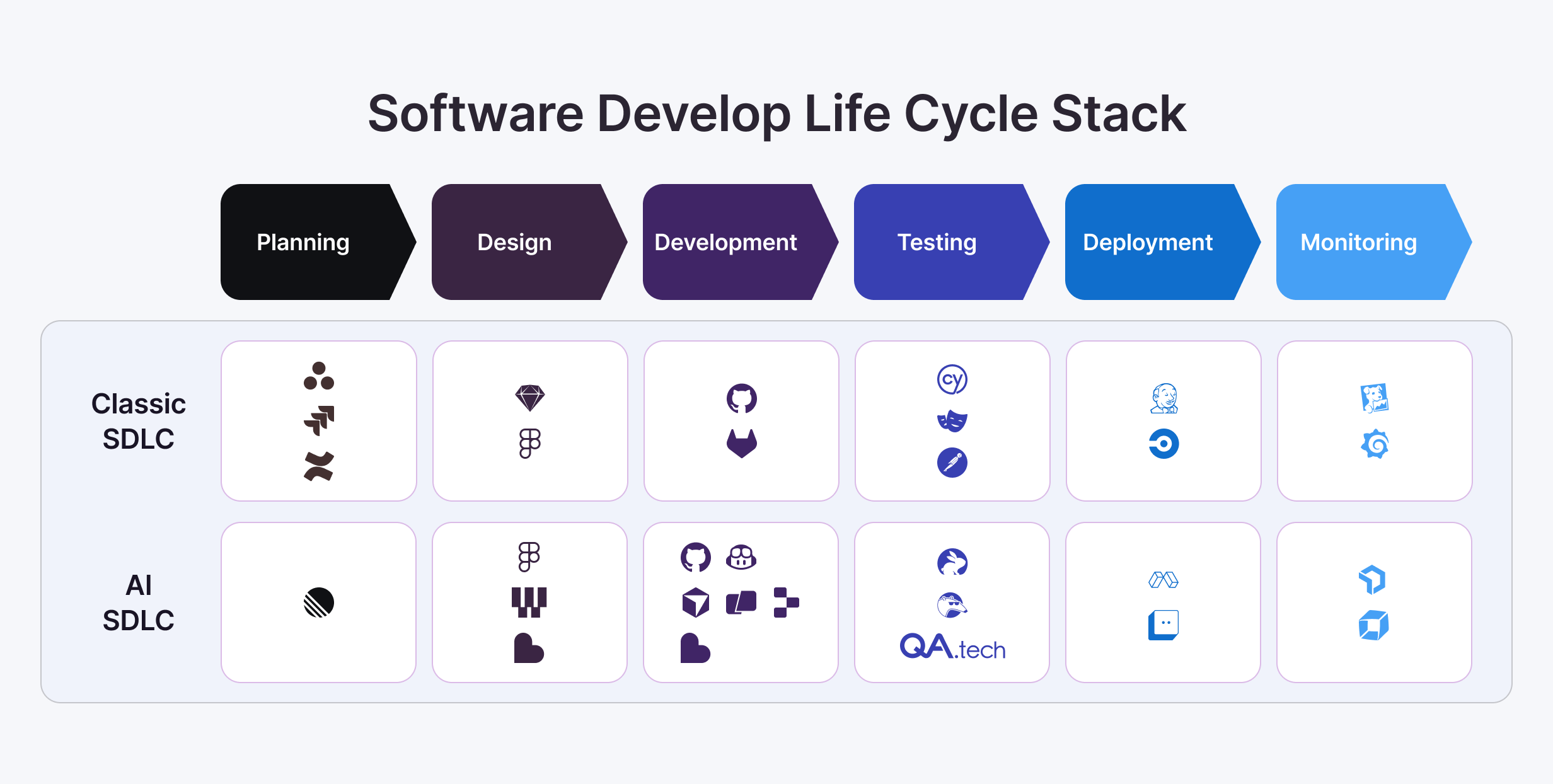
What does the AI development tool stack look like in 2026?
Daniel Mauno Pettersson has laid out his vision on the future of SDLC, where testing goes far beyond writing scripts. He has explained how agentic AI will be able to create tests automatically, run on every PR, understand contexts, and provide feedback for human review. This future is closer than you may think.
Here are some types of tools you can already count on:
Code Generation Tools
Coding tools are the foundation for building applications. They are now far ahead of simple IDEs or autocompletes. These tools fall into multiple categories, such as:
- Chat-based: They are passive and only answer to your queries when asked. Most context-aware coding tools have an integrated chat capability. Some examples of this are ChatGPT, Claude Code, and Copilot.
- Context-aware: Tools like Cursor, Windsurf, and Context7 understand your entire codebase, regardless of how large it is. As expected, they can complete the code line you’re writing. However, they also know what utility function and naming conventions are being used and how your authentication works. When you ask them to add a feature, they can modify multiple files and folders to achieve this.
- Agentic AI: These tools go a step further. Apart from suggesting lines, Claude Code, Kiro AI (Amazon), GitHub Copilot, Traycer AI, and Blackbox AI also plan for your next features, break them down into steps, work on each step autonomously, and connect them later by executing code changes across multiple files.
AI code review tools
You can’t always rely on human reviewers. That’s why AI code review agents have become an essential part of the development tools stack.
These tools serve as the first line of defense before testing. They provide useful feedback, speed up the process, and reduce manual developers' workload, which allows them to focus on critical issues. Tools like CodeRabbit and Qodo are used as part of the modern stack and provide review on every PR. SonarQube or similar tools are used for security and quality gates, while some teams use built-in code review features of Cursor and Copilot.
Review agents catch the mechanical problems, which leaves human reviewers on architectural correctness and business logic.
Best AI testing tools and agentic QA platforms
You are automating code generation and code review process, so why are you still manually writing test scripts for your app features? The solution lies in AI-based testing tools. However, not all AI testing is created equal.
QA.tech runs autonomous AI agents that crawl an application, build a knowledge graph of how it works, and generate tests from the flows they find.
"Think of it as a site map on steroids: every screenshot, every pull request and every conversation with the agent goes into one context store. That gives the agent something close to spatial memory. It knows it has seen a screen before, and it knows how to get from one part of the product to another." – Daniel Mauno Pettersson, CEO, QA.tech
On the pull-request side the agent tests every PR against the preview environment, an approach we call dynamic PR testing. It classifies the diff first, skips PRs that only touch docs or infrastructure, matches the change to existing tests, and writes new ones only where coverage is genuinely missing. Most PRs generate no new tests at all.
Other tools in this space take different approaches, and it is worth reading up on agentic testing compared with traditional automation before you shortlist, alongside the best E2E testing platforms. Qodex uses an agentic method for API testing and security, while testRigor generates autonomous tests that adapt as your UI changes, automatically fixing broken tests without human intervention.
Every platform in this category claims to learn the application. They diverge on what happens next: whether the agent runs on a schedule against a full suite, or scopes itself to what changed in a given pull request.
AI observability tools
Observability is considered to be the key future technology, especially as AI and agentic development take center stage. In a modern dev tool stack, AI-powered observability doesn’t just wake you up at 2 a.m. with an alert. It wakes you up with the solution.
Modern platforms like Datadog now include AI features like LLM observability. These provide end-to-end tracing across different AI agents with metrics like latency, token usage, and logs. Vercel offers built-in AI that has the ability to explain why monolith builds fail or provide insights into what has changed between builds.
Not every team needs every observability feature. Most do just fine with basics. Some level of AI functionality does pay off, because it turns observability from reactive “this is what’s broken, and I need to figure it out" into proactive "this is what’s broken, here’s why it happened, and here are some potential fixes.”
What are the limits of AI testing?
Two limits are worth knowing before a pilot. The agent drives the product through its interface, so it needs a UI to work with. A backend-only change, or a microservice with no frontend, is not something it can reach that way. And an agent that explores a product will find things a scripted suite never looks at, which means the first runs surface real bugs that have been sitting there for months. That is the point, but it does mean the first week looks worse before it looks better.
The related trap is scale. Running a large regression suite on every change is not the goal and never was. A hundred tests at a one percent flake rate means a red build essentially every run, and a team that learns to ignore red builds has lost the value of testing entirely. The workable shape is a small critical-path suite, sign-up and payment and whatever else takes revenue down when it breaks, plus dynamic testing scoped to the diff.
Why AI Testing Is Not Optional in 2026
Even though AI code generation tools can sometimes produce unexpected results or small errors in logic that compile successfully but won't work in practice, they are generally fast. It’s the “after coding phase,” or verification, where teams often get stuck.
Manual testing slows this process down, which is why modern AI QA fits right in the middle of your pipeline, between rapid code generation and stable deployment. AI-powered testing will help you maintain efficiency throughout development. Plus, with AI agents running continuously on your app, you will also gain confidence to ship features faster.
How do you build an AI dev tool stack in 2026?
- Start where it hurts most, or start with the coverage gaps your current tests never reach and let an agent explore those.
- Move to a context-aware editor such as Cursor or Windsurf. This is the cheapest gain on the list.
- Automate pull-request review with a GitHub app such as CodeRabbit or Qodo.
- Add agentic testing on the same pull requests, so the code review and the functional check land together before merge. Teams that do this add agents to an existing workflow rather than waiting for a rewrite.
Keep what already works and add agents to the repetitive parts one at a time. Crystal Intelligence took this route on a canvas-heavy UI and cut regression from weeks to hours.
For engineering leaders planning a 2026 stack, autonomous QA is the layer that keeps testing from becoming the bottleneck.