
With the rise of AI, being a software developer has become both easier and more demanding. After all, ChatGPT can now be used for coding (among many other things), which has made many CEOs think they don’t even need junior developers anymore. At the same time, senior developers find themselves under pressure to complete more tasks in the same amount of time.
As the pace accelerates, startups and smaller companies are finding it harder to keep up. To move faster, their developers often focus on shipping new code and features, leaving little time for traditional QA processes to wrap up. Unsurprisingly, this approach can destabilize the product and cause bugs and other errors to appear.
Instead of simply speeding up the processes and hoping everything will be fine, companies can use AI to support code validation and testing, as this EY 2025 report shows. In this article, we will explore [how AI](/blog/how-ai-generated-tests-are-changing-developer-workflows-forever) can further improve developer efficiency for teams that need to move fast, without breaking the systems they’re building.
Efficiency Comes from Eliminating Friction
While AI tools generally help developers produce code faster, that brings new challenges. Both QAs and developers have to go through more code in less time, and understanding or interpreting what has been written already can become increasingly difficult.
Although AI is commonly used to speed up the process of writing, using it for interpreting, clarifying, and debugging existing code is just as important, if not more so.
According to the recent DORA study published in September 2025, AI adoption among developers has increased compared to 2024 and now stands at around 90%. A large share, around 65% of surveyed professionals, said they rely heavily on AI for software development, while 59% report improved code quality.
However, this report also highlights a trust paradox. While 24% of developers state they trust AI, 30% of those who use it still don’t find it fully reliable. As a result, despite its widespread adoption, developers still remain cautious and restrict themselves from automating all of their work with AI.
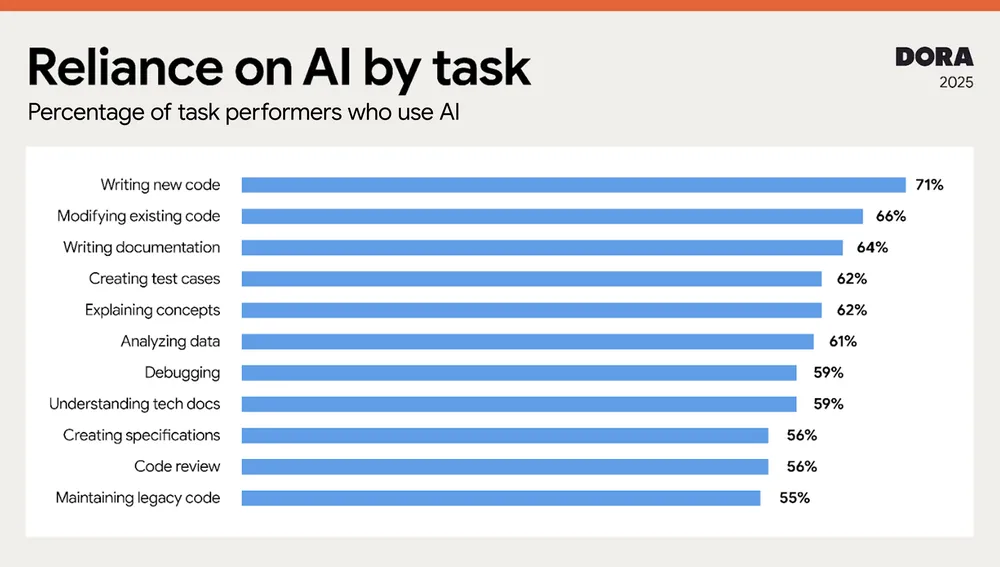
Source: DORA study: https://blog.google/technology/developers/dora-report-2025/
The way AI tools are perceived at the moment reveals the best possible use case for developers. While they are widely incorporated in workflows, they are still viewed primarily as supportive tools, used to enhance the efficiency and productivity of software developers rather than completely substitute human work, and more importantly, human thinking and creativity.
QA.tech is built with this in mind, treating AI agents as supplementary tools that boost productivity and earn trust over time. For example, Upsales replaced 320 hours of manual testing using QA.tech’s agents. In the process, our AI agents found two crash-causing errors, including a mass mailing that would have prevented messages from reaching any users.
Trust is key here. When developers know that the feedback they receive is accurate, they can move faster. Teams can rely on our tools to eliminate friction and debug the code they’ve produced. Without constantly going back and checking if everything is good to go, developers can build new features, improve UX/UI, and allow their product to stay competitive and meet market demands.
It’s hard to imagine that some executives still question the value AI tools can bring to their company. That’s why our goal is to build trust and demonstrate through results that our processes actually work.
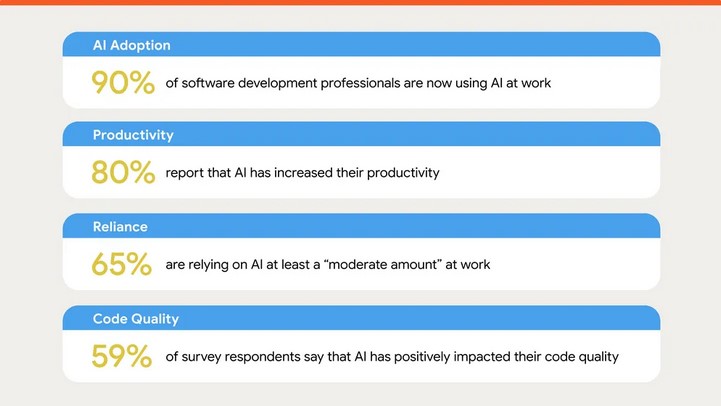
Source: DORA study: https://blog.google/technology/developers/dora-report-2025/
The Biggest Bottlenecks Happen After the Code Is Written
You may think that development speed is determined by how quickly developers produce new code, but that’s not entirely true. The speed is determined by how quickly QAs can confirm that the code is safe to use.
The misconception that AI speeds up the process simply by automating code writing is widespread. But when you think about it, it makes perfect sense. If a developer produces a certain amount of code in a given time and AI helps them double the amount for the same time period, it seems logical to assume you would be moving twice as fast now.
However, people often overlook the fact that more code means more work. Doubling the code means doubling the work needed for debugging and checking whether the code is safe to use.
After code is written, time is commonly lost on a few typical processes:
- Reproducing a bug
- Determining whether a change has introduced risk
- Waiting for someone to review
- Waiting for QA to validate
- Rerunning tests after small changes
Instead of using AI only to create more code, you can use it to accelerate the process after the new code has been written. These pauses tend to cost more time than expected, and they also break developer momentum. It’s difficult to stay in flow when your progress constantly depends on waiting for someone else to take care of these steps.
Therefore, maximizing developer velocity with AI is best achieved by eliminating these bottlenecks after the code is written, not by producing code faster. Among the areas we’ve listed above, QA is often the biggest problem, especially at companies that are trying to scale quickly. This is due to the very nature of the processes that need to be run.
Even though developers are adopting AI tools, and almost all software companies now use them in some form, the adoption varies across categories. However, the efficiency gains are clear regardless.
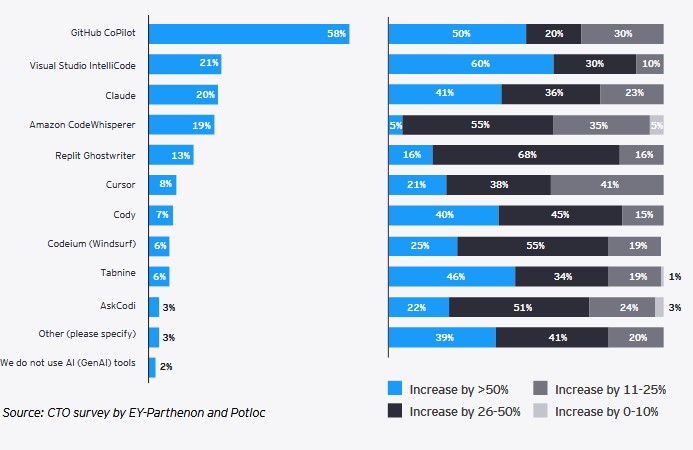
Source: EY Report: https://www.ey.com/content/dam/ey-unified-site/ey-com/en-se/noindex/2025/ey-parthenon-cto-report-2025.pdf
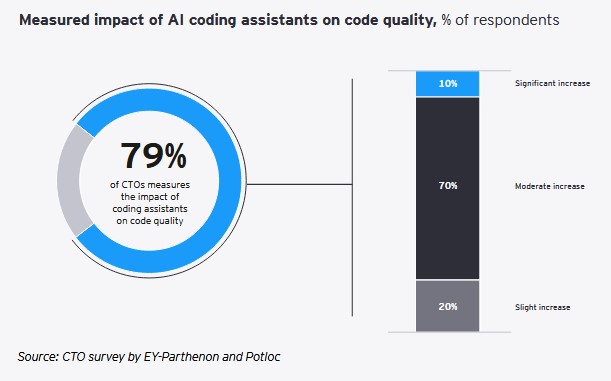
In this report, improvement is two-fold: faster production and improved code quality.
When it comes to code quality, 70% of the surveyed developers reported a moderate improvement, 10% reported a massive improvement, while 20% saw little to no improvement at all. As for CTOs, 79% reported a measurable positive impact on coding quality.
Source: EY Report: https://www.ey.com/content/dam/ey-unified-site/ey-com/en-se/noindex/2025/ey-parthenon-cto-report-2025.pdf
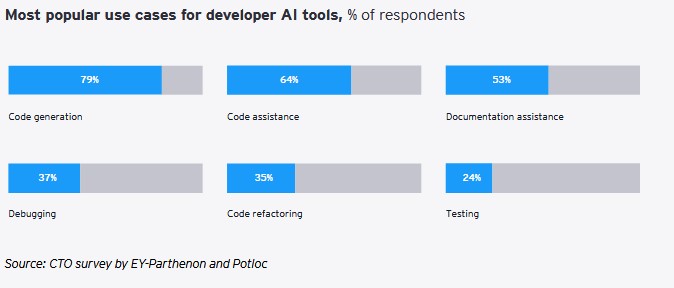
Although AI reaps clear benefits, its widespread adoption will likely take more time. Developers are currently using AI for code generation in 79% of the cases, which comes as no surprise, as it is the most obvious use case for these tools. However, only 24% are using it for code testing.
At QA.tech, we believe this represents a chance to unlock a whole new dimension in the development cycle. Our AI QA agents are designed to remove the biggest bottlenecks in code production and speed up the process.
Source: EY Report: https://www.ey.com/content/dam/ey-unified-site/ey-com/en-se/noindex/2025/ey-parthenon-cto-report-2025.pdf
Why AI-Powered QA Is Essential for Unlocking Efficiency
Every self-aware lead dev will tell you that great QA makes their job easier. However, shifts across the industry are changing workflows. The demands are getting bigger, and teams that are not using emerging AI tools are bound to lose pace. You may value your current processes and workflows, especially if they’ve brought success to you in the past, but the changing environment won’t let you stand still. The market is unforgiving.
Companies need to evolve, or they risk being defeated by competitors who have embraced these changes. We know how you got things done before: manual scripts, brittle selectors, and trustworthy (but very slow) maintenance cycles. However, the speed and results these workflows are producing are no longer enough.
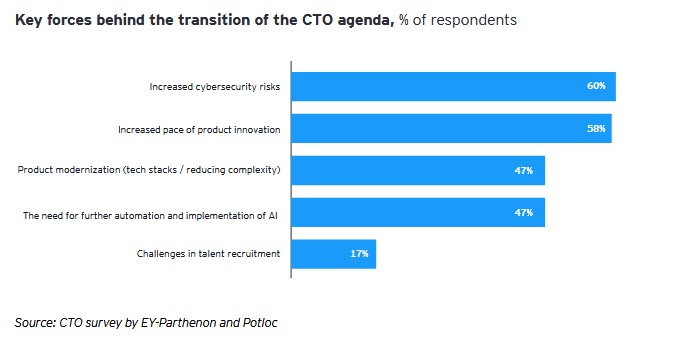
In the report mentioned above, EY states that 47% of the surveyed CTOs feel that the need for further automation and implementation of AI is a major force behind the transition of the CTO agenda.
Back in the day, the CTO role was purely technical, responsible for maintaining infrastructure, overseeing architecture, and ensuring systems run smoothly. That won’t cut it anymore.
Source: EY Report: https://www.ey.com/content/dam/ey-unified-site/ey-com/en-se/noindex/2025/ey-parthenon-cto-report-2025.pdf
CTOs are now required to deliver lasting business impact through their technical abilities, and mastering relevant AI tools has become essential to remain competitive. They still care about risk mitigation, but now they must deliver measurable growth as well. QA leads are demanding reliability from their teams, while PMs want stability and to get things done without adding more specialized workforce.
QA.tech agents fit perfectly in this broader picture. They can send positive ripple effects throughout your organization.
AI Tools Are the Future
The developer domain is changing rapidly. We are experiencing shifts like never before in human history, and companies need to adapt or risk being left behind.
QA processes are important during the product development stage. You can’t neglect them, but if you continue doing them an old-fashioned way, you’ll inevitably fall behind. Automation is the way to go, and QA.tech’s AI agents are built to solve all your issues and speed up your processes.
Investing in AI tools that can provide reliable results for your company should be your key focus in 2026 and beyond. Remember, we are not at war with machines. Those companies that are able to implement AI in the right way will be the ones who can ship faster and safer. As a result, their products will have a greater impact on the market.
See how engineering leaders use QA.tech to hold release velocity without a growing QA backlog.