
As we head into 2026, the role of QA engineers is evolving. They can no longer rely solely on test case execution and manual validation. Instead, they need to be strategic thinkers, data readers and interpreters, automation enablers, and AI collaborators who blend their technical knowledge with business insights and soft skills.
If you want to stay ahead of the curve, check out the list of important skills QA engineers will likely need in 2026 and beyond.
Agentic AI and Autonomous Testing Proficiency
The next phase of AI in QA will go beyond simply using AI tools. In fact, it will focus on leveraging agentic AI systems that are capable of reasoning and acting semi-autonomously. For a look at platforms already working this way, see the best agentic QA tools in 2026. These AI agents can perform tasks such as dynamic test case generation, failure analysis, and defect clustering; they can even make reasoning-based decisions about regression prioritization.
Traditional, Exploratory testing depends on human intuition and domain knowledge, but with the involvement of AI, we can have data-driven and intelligent exploratory testing. The agents can navigate through the interface to know the behaviour, learn from the interaction, and understand the anomalies. By the use of behavioral analytics and reinforcing the learning, the journey of testing can be stimulated by knowing hidden defects and unknown system responses. Furthermore, AI can relate the API responses and logs faster than humans.
Let’s illustrate this with an example.
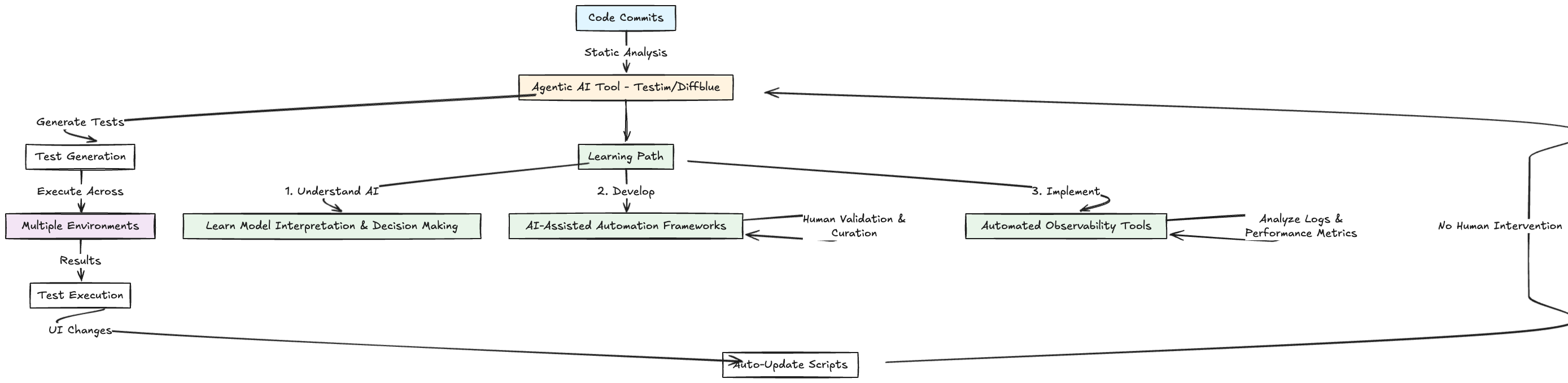
Imagine a QA team that uses an agentic AI tool, like Testim or Diffblue. This system statically generates tests based on code commits, executes them across multiple environments, and updates scripts when the UI changes, all without human intervention.
To foster this kind of AI-driven capability, you need to learn [how AI](/blog/how-ai-generated-tests-are-changing-developer-workflows-forever) models actually interpret behavior. Try to understand how they make decisions and why they choose specific actions during testing. Additionally, get involved in developing AI-assisted automation frameworks, where humans validate and curate AI output. Finally, consider exploring automated observability tools that can analyze logs and performance metrics autonomously, without the need for manual oversight.
Complete Process Automation (Including Micro-Automations)
Soon, the biggest bottleneck in QA won’t be test execution; it will be manual quality assurance processes. Forward-thinking teams are already automating repetitive, low-value processes that slow down delivery, such as daily reporting, environment setup, defect notifications, and test data generation.
As you can see, this broader approach, often referred to as Complete Process Automation (CPA), goes beyond testing. For example, a QA manager could combine Python scripts, Jenkins pipelines, and Slack bots to automatically run sanity tests after deployment, provide team channels with a summary of test results, and dynamically create JIRA bugs for failed tests.
By establishing a self-sustaining QA ecosystem, these micro-automations free up engineers’ time and enable them to concentrate on strategic projects, like shift-left quality, test optimization, or AI-driven analytics.
To accomplish this, your QA specialists should master workflow automation tools like Power Automate, Zapier, and custom Python scripts. Identifying manual pain points throughout the QA lifecycle and automating them can turn efficiency into a competitive advantage for your company.
Proficiency in Data-Driven Analytics and Testing
By 2026, data literacy will become a fundamental QA skill. QA professionals will need to base their decisions on empirical insights rather than intuition, as AI-powered platforms and predictive analytics become more commonplace.
Contemporary QA dashboards already use data analytics to determine high-risk areas. They rely on past defect density, trends in flakiness, and the effect of recent code commits on production stability.
By interpreting this data, QA engineers can use predictive defect modeling and risk-based testing to avoid failures rather than just respond to them. Still, in order to develop this ability, they need to be technically fluent in Python and SQL for advanced analytics and proficient in tools like Grafana, Tableau, and Power BI.
Data-driven QA is expected to bridge the gap between business intelligence and quality assurance.
Awareness of Security and Compliance (QA + DevSecOps)
Due to the increase in data breaches and API exploits, quality validation now encompasses the security domain, as well. Unsurprisingly, QA engineers are expected to start acting as security gatekeepers, too.
In order to automatically identify vulnerabilities during smoke or regression runs, QA teams will integrate tools like OWASP ZAP or Burp Suite into CI/CD pipelines. Data encryption checks, authentication processes, and conformance to standards like ISO 27001, SOC 2, and GDPR are all expected to be part of the validation process.
For QA professionals to succeed, a DevSecOps mindset is necessary. This includes incorporating security checks early in the testing process and understanding how privacy, encryption, and compliance regulations affect test design.
Proficiency in Cloud-Native and Environment Virtualization
In today’s era of hybrid and multi-cloud architectures, QA engineers have to validate across distributed environments that replicate real-world production systems.
When third-party systems or APIs aren’t available, QA teams can mimic them by using service virtualization. They can use Docker and Kubernetes to create ephemeral test environments on demand and achieve cost-effectiveness and scalability.
Practical experience with Google Cloud Testing Frameworks, Azure Test Plans, and AWS Device Farm will become essential. With cloud-native QA expertise, teams will be able to maintain consistency, speed, and flexibility across dynamic deployment pipelines.
Superior Leadership and Advanced Soft Skills
In the future, soft skills are expected to become a true differentiator, especially as automation and artificial intelligence take over repetitive tasks.
Transforming technical quality metrics into meaningful business insights requires strong communication skills. QA transformation projects will be led by change management, who will require even more cooperation and communication across agile cross-functional teams.
A QA lead should exemplify quality leadership, not just manage test ownership. They should be in charge of defect triage meetings, where the emphasis is on enhancing the CI/CD process to avoid future problems rather than on pointing fingers.
If you want to develop these skills, make sure to practice conflict resolution and stakeholder management. Also, participate in workshops on communication and leadership, as they can be a useful asset. Take the time to mentor younger testers and, most importantly, foster a culture of shared quality ownership.
Constant Learning and Flexibility
With new frameworks and AI tools emerging every quarter, the QA ecosystem has been evolving at a breakneck speed. Therefore, the most valuable skill in this regard is adaptability and a willingness to learn, unlearn, and relearn.
QA specialists should set aside some time to try out new tools, support open-source testing projects, and maintain relationships with international QA communities. The hallmark of a future-ready tester will be a personal innovation portfolio that showcases experiments, frameworks, and custom automations.
QA.tech's New Frontier: Generative AI
In QA engineering, generative AI (GenAI) is revolutionizing the creation, optimization, and maintenance of test assets.
By 2026, AI will evolve from merely supporting testing to acting as an one big collaborator — one capable of reasoning through complex scenarios, generating synthetic test data with the specific domain intelligence, co-designing adaptive test strategies, and autonomously simulating real user behavior to validate end-to-end experiences.
Here are some examples of generative AI in QA:
- Using QA.tech to automatically create scenarios and test cases
- Relying on LLMs to identify likely root causes and analyze defect patterns
- Creating synthetic data for security or performance testing that remains realistic while adhering to data privacy regulations
To improve your GenAI testing skills, start by learning tools such as Functionize, Katalon's TestOps AI, or customized OpenAI API integrations. Also, don’t be afraid to experiment with prompt engineering; that way you can create excellent test generation inputs. Finally, stay informed on ethical and responsible use of AI in QA procedures.
Conclusion
In the near future, QA engineers will be more than just testers; they will also act as AI collaborators, process innovators, and quality enablers. Those who can combine automation, AI, data insights, and human intelligence to drive end-to-end quality are expected to be at the forefront of quality assurance in the future. Our ebook Past the Bottleneck covers how QA teams make that shift in practice.
Start adding AI to your QA skillset right now. Sign up for a free QA.tech account and see how AI can help you in your day-to-day tasks and make your life more organized and time-saving.
These shifts also change what engineering leaders should expect from a modern QA function.