TL;DR: the best E2E testing platforms in 2026
The best E2E testing option in 2026 depends on who owns the tests. For teams that want E2E coverage without building and maintaining a test codebase, QA.tech leads the autonomous platforms – agents test by goal, in plain English, through the UI, on every pull request. For engineering teams that want tests as code in their repo, Playwright is the default framework and Cypress the developer-experience favourite. testRigor, Momentic, and mabl fill the low-code middle; QA Wolf is the managed-service route; Katalon the all-in-one suite; Selenium the veteran; and BrowserStack the execution layer underneath whichever you pick. Decide the operating model first – comparing a framework to a platform on features is how teams buy the wrong thing.
End-to-end testing verifies complete user journeys – sign up, log in, add to cart, check out – through the real UI, the way a user experiences them. It's the layer that catches what unit and integration tests can't: the moments where everything works in isolation and the journey is still broken.
The market for it has split into two different purchases that get compared as if they were one. A framework (Playwright, Cypress, Selenium) is free code you build a suite with – powerful, and yours to maintain. A platform takes over some or all of the authoring and maintenance work, up to fully autonomous agents that write and adapt the tests themselves. Most bad tooling decisions we see come from putting these side by side on a feature checklist. So this list is organised by operating model.
Quick Comparison
| Tool | Model | Who writes the tests | Maintenance when UI changes | Native mobile | Pricing |
|---|---|---|---|---|---|
| QA.tech | Autonomous platform | AI agents, from plain-English goals | Agents adapt – no scripts to break | Yes | Plans via demo; free POC |
| Playwright | Code framework | Your engineers | Yours – selectors, waits, fixtures | Limited | Free, open source |
| Cypress | Code framework | Your engineers (JS) | Yours | No | Free OSS; Cloud paid |
| testRigor | Low-code platform | QA staff, plain-English DSL | AI re-interpretation | Yes | Quote |
| Momentic | Low-code platform | Humans author, AI executes | Intent locators self-heal | No | Quote |
| mabl | Low-code platform | Humans in low-code editor | Auto-healing, partial | Mobile web | Quote |
| QA Wolf | Managed service | Their engineers | Outsourced (SLA) | Yes | Quote |
| Katalon | All-in-one suite | Mixed-skill teams | AI-assisted healing | Yes | Free tier; paid |
| Selenium / WebDriverIO | Code framework | Your engineers | Yours, most of anyone's | Via Appium | Free, open source |
| BrowserStack | Execution layer | n/a – runs your suite | n/a | Real devices | Paid plans |
Autonomous Platforms
1. QA.tech
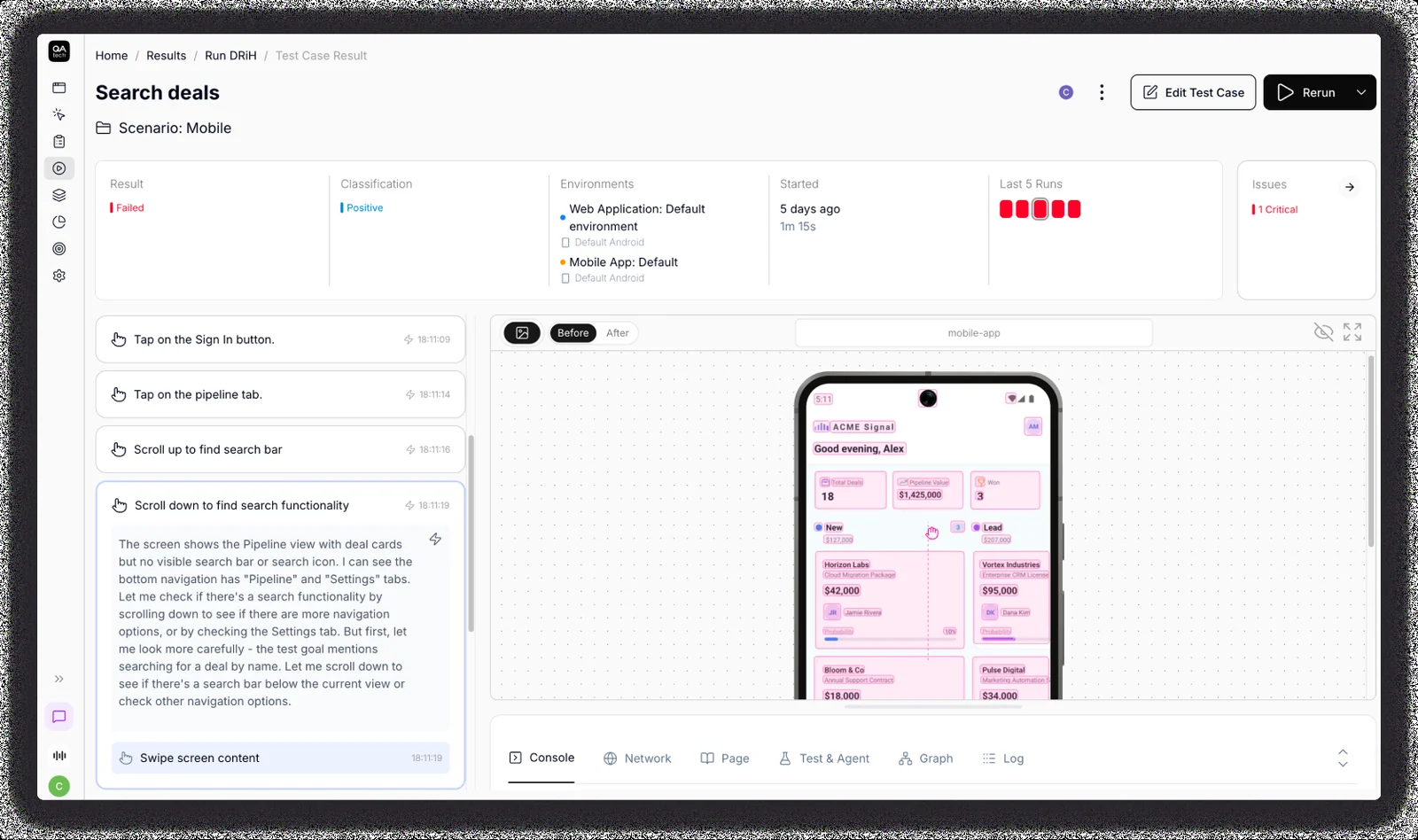
Our own platform, so read this knowing where it comes from – but E2E is the exact problem it was built to remove. You describe the journey in plain English ("sign up as a new user and verify you land in the dashboard"), and an agent completes it through the UI like a human tester: looking at the screen, understanding intent, verifying the outcome. No selectors, so there's nothing to break when the design changes – the agent just finds the new way through. Agents build a knowledge graph of your product on onboarding, probe edge cases and empty states beyond the happy path, and run dynamic tests on every pull request via the GitHub app.
E2E also no longer stops at the browser: the same agents run API tests directly, writing their own assertions against the live response.
The economics are the point. Teams running scripted E2E suites spend 20–30% of QA time repairing tests that broke for reasons unrelated to product quality – it never gets a ticket, and coverage stops growing because of it. Removing that tax is what "autonomous" buys you: one customer replaced ~320 hours of monthly manual testing with agents, and regression cycles that took days routinely drop to a couple of hours.
Best for: SaaS and product teams that want E2E, regression, and exploratory coverage owned in-house without owning a test codebase – including teams where PMs and designers contribute tests.
Honest limits: if your engineers specifically want test code in the repo, that's the framework route below.
Pricing: tiered plans – Starter, Growth, and Enterprise. It starts with a demo and a free proof-of-concept on two or three of your most critical journeys, so you see it working on your own app before committing.
2. testRigor
Plain-English test scripts executed against the UI, with visual/contextual element identification instead of selectors – so tests survive refactors that would break a framework suite. Its distinctive trick is generating tests from real production user behaviour. Authoring lives in testRigor's cloud console, which suits manual-QA-heavy organisations better than engineering-led ones.
Best for: transitioning large manual QA teams into automation without code. Pricing: quote.
3. Momentic
Intent-based locators – the AI finds the right element on each run from layout and purpose rather than a stored selector – wrapped in a low-code editor where humans author each step. Resilient execution with human-driven authoring; web only.
Best for: teams replacing Playwright or Cypress with something lower-maintenance, without going fully autonomous. Pricing: quote.
4. mabl
One of the earliest ML-on-testing platforms, and its auto-healing is mature. Still selector-aware underneath: minor UI changes heal, structural refactors don't. Covers web, mobile web, API, and cross-browser in one place.
Best for: teams with automation experience that want reduced (not eliminated) maintenance in a low-code editor. (QA.tech vs mabl.) Pricing: quote.
Code Frameworks
5. Playwright
The 2026 default for code-based E2E: first-party Chromium/Firefox/WebKit support, auto-waiting that removes most flakiness, parallelism, trace viewer, and now first-party test agents that help plan, generate, and heal tests. The output is code in your repo, which is both the appeal and the bill – selectors, fixtures, CI, and infrastructure are yours to run, whoever (or whatever) wrote them.
Best for: engineering teams that want full control and will resource suite ownership. Pricing: free, open source.
6. Cypress
The developer-experience pick: tests run in the browser with time-travel debugging, and the feedback loop is quick in a way developers like. JavaScript-only, narrower browser coverage than Playwright, and heavy parallel workloads push you into paid Cypress Cloud.
Best for: JS-first teams optimising for DX on Chromium-family browsers. Pricing: free OSS; Cloud free tier, then paid.
7. Selenium (and WebDriverIO)
Selenium still runs a huge share of the world's existing suites and speaks every browser and language; WebDriverIO is the nicer JavaScript face on the same protocol, with Appium for native mobile. For new projects most teams now start elsewhere – raw WebDriver is the highest-maintenance option on this page – but the ecosystem and job market are unmatched.
Best for: existing Selenium estates and unusual browser/language requirements. Pricing: free, open source.
Managed, All-in-One, and Infrastructure
8. QA Wolf
A managed service rather than a tool: QA Wolf's engineers build and maintain a Playwright/Appium suite for you under an SLA. Legitimate if you've decided to outsource QA entirely – just know that priorities travel through an external team, ramp takes months, and knowledge of how your product should behave accumulates outside your walls. (QA.tech vs QA Wolf.)
Best for: funded teams outsourcing QA wholesale with a long planning horizon. Pricing: quote.
9. Katalon
The broadest all-in-one suite – manual, web, mobile, API, performance – with AI layered throughout for generation and healing. The AI enhances a human-driven workflow rather than replacing it; good consolidation play for mixed-skill teams that want one platform for everything.
Best for: consolidating several testing tools into one, with a QA org that owns strategy. Pricing: free tier; paid plans.
10. BrowserStack
Not an authoring tool – the execution layer. Run whatever suite you have across thousands of real browsers, OS versions, and devices, with live manual sessions when you need hands on a real iPhone. Pairs with everything above.
Best for: teams whose users are on browsers and devices the team doesn't own. Pricing: paid plans by product.
How to Choose an E2E Testing Platform
Decide the operating model first, then compare inside it.
Who owns testing? Engineers who want code: Playwright (or Cypress for DX). Nobody with bandwidth to own a suite: an autonomous platform – that's QA.tech's case, and the maintenance-tax math above is the argument. A large manual-QA org: testRigor or Katalon. Nobody at all, by choice: QA Wolf.
How fast do you ship? This is the question that separates the models in practice. A weekly-release team can keep a framework suite healthy. A team shipping daily – especially with AI coding agents in the loop – generates UI change faster than script maintenance can absorb, and E2E coverage quietly rots. The faster you ship, the stronger the case for tests that adapt by understanding intent rather than tests that break by design. (Agentic testing vs traditional automation covers the architecture difference.)
SaaS-specific advice, since it's the most common question we get: keep a small set of pinned journeys – five to ten flows that must never drift, signup, checkout, billing – and treat any failure there as a release blocker. Then let broader, adaptive coverage handle the long tail of functionality that never earns a scripted test. Trying to script the long tail is how suites grow to thousands of tests that nobody trusts; you can have 10,000 green tests and still ship a broken product if they don't test what users actually do.
Web + native mobile? Options narrow fast: QA.tech, testRigor, Katalon, and QA Wolf cover both; Cypress and Momentic are web-only; Playwright's mobile story is emulation-first.