Short answer: Every BrowserStack alternative on this page is another grid: a cheaper place to run the Selenium or Playwright suite your team maintains. Switch to any of them and you'll change the price per parallel and nothing else. If what you're paying for is the suite rather than the browsers, the alternative is QA.tech, which runs plain-language test cases against your product with no scripts and no selectors to write.
Why teams go looking
The bill. BrowserStack Automate starts at $59 a month for a single Chrome-only parallel, $175 for desktop and mobile, $225 for the Desktop & Mobile Pro tier, billed annually, with live manual testing from $29 per user and App Automate from $199 per parallel (checked 6 Oct 2026). Every number is per parallel or per seat, so five Pro parallels is about $1,125 a month before anyone writes a test. On G2, across 3,360 reviews, price (259 mentions), slow performance (312) and slow loading (288) are the top complaints. Capterra reviewers say pricing jumps quickly when you need more parallel sessions or want to add team members.
The usage. A manager at a media company told us she'd tried to cancel their renewal and was added to the conversation too late. They had manual testing and app testing activated, far too many users, and in her words were not really using it, just paying for it.
What BrowserStack doesn't do is write the tests. Automate runs Selenium, Playwright, Cypress and Appium scripts your team wrote. Generation sits in separate products, Low-Code Automation and the Test Management agents, each priced on its own. And the grid isn't where the money goes anyway. A QA lead at a UK martech company told us two or three QAs spend about 30% of their time on test maintenance. A QA engineer at a retail-software company put maintenance and debugging at 90% of his work. A QA lead at a healthcare software company was blunter: when a change breaks a test, we have no time to fix it. None of that moves when you change grid.
There's a newer version of the same bill. An engineering lead at a workforce-management software company described what parallel AI development did to his pipeline spend: what used to be stable per headcount, fifty developers costing X on the pipeline, is now a few people burning ten times that, running agents in parallel and opening twenty pull requests a day. Costlier and slower, he said, and a trade-off people need to understand if they want the velocity.
The alternative that removes the suite: QA.tech
A QA.tech test case is a goal in plain English with an expected result: sign up as a new user, verify you land on the dashboard. No scripts, no page objects, nothing to upload to a grid. The agent works from the rendered screen together with the page's DOM and accessibility labels, and drives the live app to the goal. You never write a CSS selector or an XPath, so a renamed button or a redesigned component doesn't break anything. Where a journey must never vary, you write the exact labels, URLs and order into the steps as checks, and only what you assert can fail.
It runs where the grid would: on a cron schedule, from GitHub Actions, GitLab CI or any pipeline through the API. Concurrency is set per environment rather than bought in slots; Starter includes three parallel runs, Growth and Enterprise are set to your volume. Web runs on Chrome, so Chromium only, with configurable mobile and tablet viewport presets; a phone preset is Chrome at a phone viewport, not Safari's engine. Native iOS and Android run on cloud simulators and emulators from the build your CI uploads, with real devices listed as coming soon. Pricing is metered on test executions rather than parallel slots, test creation is unlimited, and mobile and dynamic testing on pull requests are on the Growth plan and up.
That last paragraph is the honest version, and it rules us out for some of you. If you need real Safari on physical iPhones, keep a grid for those flows; we cover when that's needed in how to test your website and app on an iPhone.
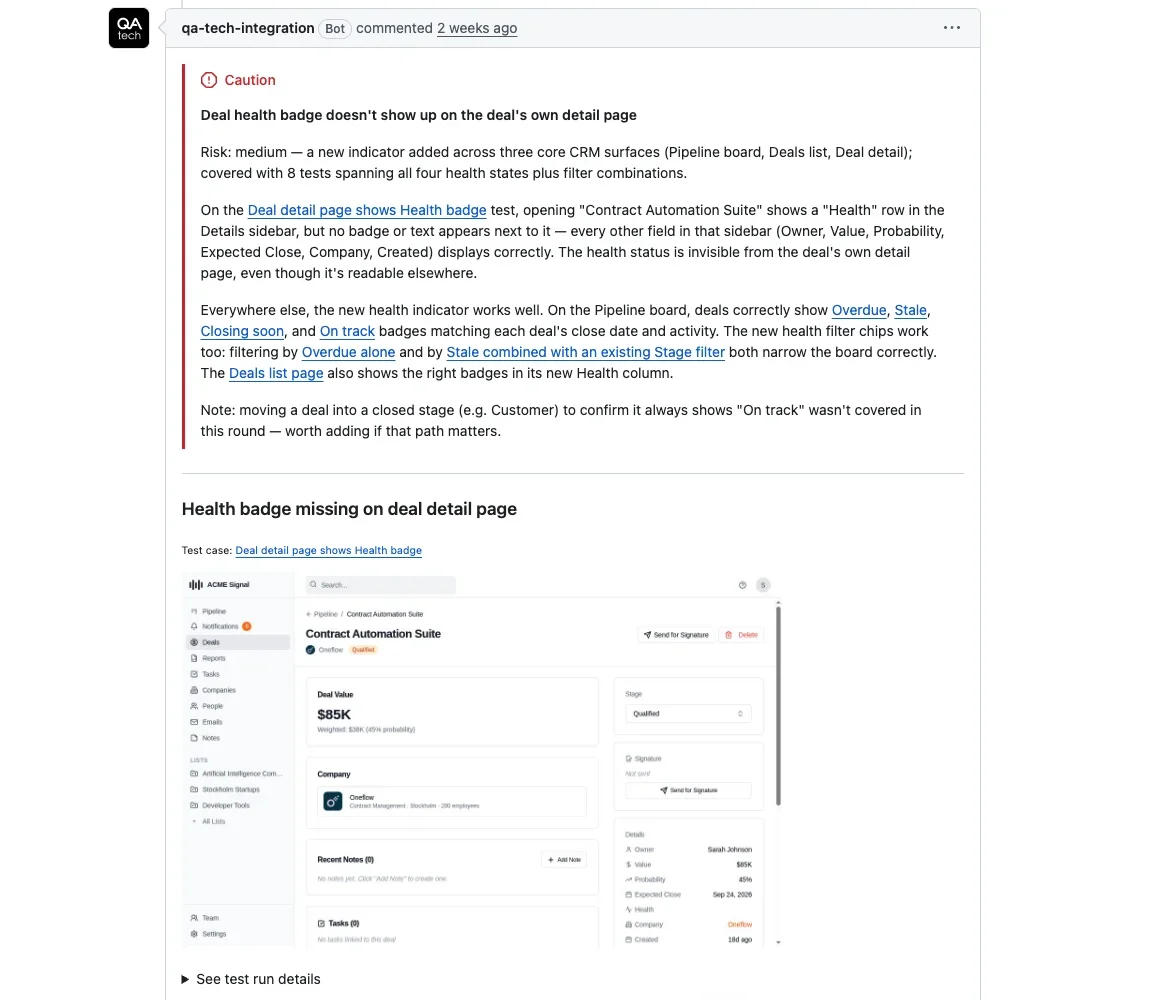
A result on a pull request from our demo CRM: the new health badge worked on the pipeline board and the deals list, and was missing on the deal's own detail page. The eight tests ran on QA.tech's own browsers, so nothing here hit a per-parallel meter.
On the pull request, dynamic testing reads the change, picks the flows it can reach, runs them against the preview deployment and posts a native GitHub review with a results table; GitLab gets a results comment on the merge request. A product lead at a hardware-and-software company who runs full Selenium regression every Friday told us he isn't looking for regression from a new tool, he wants something pointed at the change that tells him what it finds. That shape is a small scheduled set of flows that must never break, with everything else tested from the change.
Daniel Mauno Pettersson, QA.tech's co-founder and CEO, is direct about where the cost lands instead: creating a test case is close to free, running one costs more than a traditional test, so you have to be smarter about what runs when. Trading a per-parallel meter for a per-execution one only helps if you stop running everything every time.
What the other grids actually change
There are half a dozen of them and they are the same trade at different prices. Entry tiers sit somewhere between $30 and $200 a month, almost always per parallel or per seat, with real devices on the mid tiers and up and a per-minute meter underneath. Some bolt a test-writing agent on as a second product with its own price. Every one of them runs the scripts you already have, and that is the whole offer: a cheaper or faster place to execute a suite you still own.
So the saving is real and it is bounded. Move five parallels from one vendor to another and you might take a few hundred dollars a month off the bill. The two or three QAs spending a third of their week on maintenance keep spending it, because none of these tools writes a test case and none of them stops one breaking.
One engineering lead who ran a grid vendor's test-writing agent head-to-head with QA.tech on the same pull requests told us the two-step generate-then-run flow got stuck in loops and had to be restarted, and that QA.tech's test cases were more relevant and less flaky from the first generation.
There are two routes off the grid that aren't another grid.
Run Playwright on your own CI. Playwright ships Chromium, WebKit and Firefox with emulated mobile viewports, and GitHub Actions gives you 2,000 free minutes a month, then Linux runners at $0.006 a minute. No licence, no real devices, and every flake and every broken selector is yours. For a web team that mostly needed somewhere to run Playwright, this is the honest BrowserStack replacement, and it leaves the suite problem exactly where it was.
Rent real devices by the minute from a hyperscaler. AWS Device Farm is $0.17 per device minute, or $250 a month per unlimited slot, first 1,000 minutes free, supporting Appium, Espresso, XCUITest and Selenium, billed on your AWS invoice. If you were about to say Firebase Test Lab, Google has deprecated it, with full shutdown on 30 September 2027.
And the third route is the one this page is really about: stop maintaining the suite, and the question of where to run it stops mattering.
Quick comparison
| BrowserStack | Other grids, as a category | Playwright on your own CI | QA.tech | |
|---|---|---|---|---|
| Entry automation price (6 Oct 2026) | $59 Chrome-only / $175 / $225 Pro, per parallel, annual | Roughly $30–$200/mo, per parallel or per seat | $0 licence, runner minutes | Metered on test executions |
| Priced per parallel | Yes | Usually | No, per runner minute | No, concurrency set per environment |
| Real devices | Yes | Mid tiers and up | No | Simulators and emulators; real devices coming soon |
| Runs your scripts | Yes | Yes | Yes | No scripts to run |
| Writes test cases | Separate products | Sometimes, as a second product | No | Yes, from a plain-language goal |
| Stops tests breaking | No | No | No | Yes, no selectors to break |
Also in this series: Selenium alternatives, Playwright alternatives and TestSprite alternatives.