Short answer: Six of the Selenium alternatives below are frameworks, and the best of them, Playwright, fixes the waiting and the runner and the tracing that Selenium makes you build yourself. None of the six fixes the thing that sends most of the teams we talk to looking: every test is still a script tied to selectors someone maintains. The seventh, QA.tech, has no scripts to maintain, and it's covered first.
What Selenium leaves you doing
Selenium's own description is one line: it automates browsers, that's it. Version 4.50 shipped on 30 September 2026, mid-migration to WebDriver BiDi, with bindings for Java, Python, C#, Ruby and JavaScript. No runner, no assertions, no reporting, an implicit wait that defaults to zero.
The project says this about itself, which is more honest than most vendor pages manage: WebDriver does not know a thing about testing; it doesn't know how to compare things, assert pass or fail, or report. And Selenium provides tools to make functional user interaction easier, but does not help you write well-architected test suites.
On AI it ships documentation rather than tooling: an llms.txt index of the site, a runnable examples directory, and an AGENTS.md template you paste into your own project. The MCP servers it lists are third-party, and the docs say so.
What teams leave over is scale. A QA lead at a payments company told us his 1,800-case Selenium and Appium run takes seven hours. A QA engineer at an enterprise ERP vendor said a UI migration from JSP to Angular, with no functional change at all, meant one to two months rewriting XPaths and locators. An AI lead at a global consultancy described a client's Selenium-and-Appium framework as a giant thing with an issue of flaky, non-deterministic tests.
An engineering leader at a small B2B software company, running a weekly Selenium regression suite, described the gap it structurally can't close: we can deliver more code than we can test, and we don't have regression test cases for new functionality until after the release goes out.
Google's analysis of its own fleet found 14% of large tests flaky against 0.5% of small ones, with its WebDriver tests at 10% to 19% depending on the language binding.
Migrating that to Playwright gets you a better script framework. It doesn't get you out of scripts.
The alternative without scripts: QA.tech
A QA.tech test case is one line of English: sign up as a new user, verify you land on the dashboard. The agent works from the rendered screen together with the page's DOM and accessibility labels, and figures out how to get there. You never write a CSS selector or an XPath, so there's none to go stale. The one-to-two-month XPath rewrite the ERP engineer described doesn't happen, because a locator that changed isn't a thing the test case knows about. Where a journey must never vary, you write the exact labels, URLs and order into the steps as checks; the agent adapts to anything you haven't pinned, so only what you assert can fail.
It slots into the same nightly job your Selenium suite runs from, or into GitHub Actions, GitLab CI, Bitrise or any pipeline over the API. Concurrency is configured per environment rather than bought as slots; Starter includes three parallel runs and Growth and Enterprise are set to your volume. Web is Chrome, so Chromium only; native apps run on cloud simulators and emulators. You pay per test execution and test creation is unlimited, with scheduled plans, PR testing and mobile on Growth and Enterprise. There's no Selenium or Playwright code export because there's no code; definitions export as JSON or CSV.
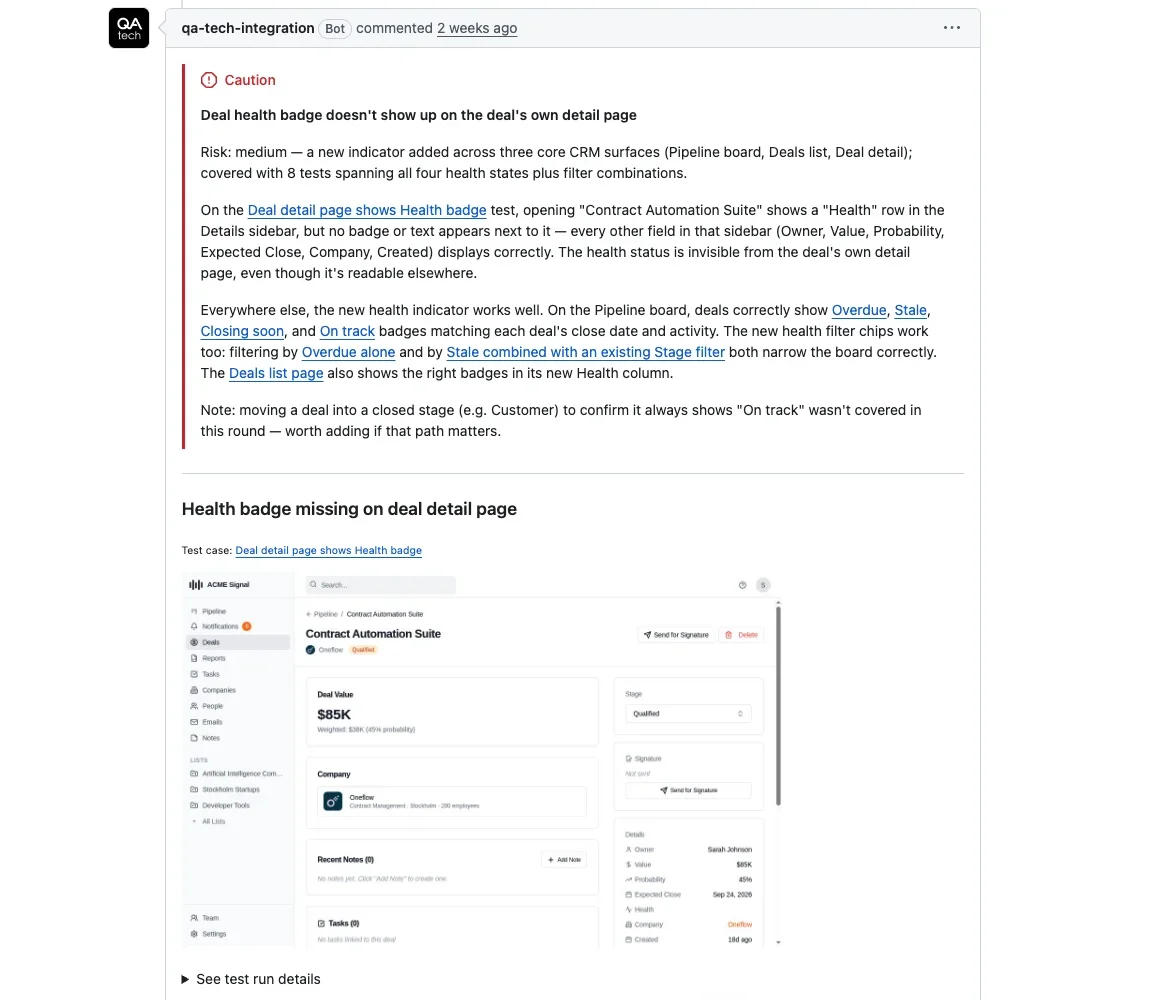
A result on a pull request from our demo CRM: the new health badge worked on the pipeline board and the deals list, and was missing on the deal's own detail page. None of the eight exists as a script; each one is a sentence the agent read and acted on.
We don't tell teams with a working Selenium suite to rip it out, and we don't pitch this as a replacement for unit or integration tests either. Keep the handful of flows that must never break, the sign-up and the payment, on the schedule they already run on. Put the long tail on dynamic testing scoped to the change, where the agent reads what moved and decides what to run. A product lead at a hardware-and-software company who already runs full Selenium regression every Friday told us exactly that: he isn't looking for regression from a new tool, he wants something pointed at the change that tells him what it finds. Don't plan to rewrite all 1,800. We have a separate guide on migrating a Selenium suite to agentic testing.
Daniel Mauno Pettersson, QA.tech's co-founder and CEO, frames the gap as the test cases nobody writes rather than the ones that break. Would you create a test case for uploading a very large file, and one for a very small one, and one for each format? Usually you don't automate those edge cases, he says, and you still want to test them once. Most teams do the bare minimum, which gives you some sense of security without telling you anything qualitative about what you just built.
The trade-off, in his words rather than ours: the agent won't follow the same path every run, and per-run cost is higher than a scripted test. He argues the varied paths find more real bugs, and that the answer to cost is being deliberate about what runs when.
Six frameworks, and what each still leaves you maintaining
Playwright. The right move for most Selenium teams and the one we'd pick too; the full Playwright vs Selenium comparison covers architecture, browsers, waits and migration. It checks the element is attached, visible, stable, receiving events and enabled before every action, records traces with DOM snapshots, ships its own runner and Chromium, WebKit and Firefox, and has first-party AI in the Playwright MCP server and the planner, generator and healer agents. Free, Apache-2.0, version 1.63. What you end up with is a Playwright suite bound to locators, which the healer repairs after it breaks. Our QA.tech vs Playwright page covers that trade.
Cypress. Runs inside the browser, Cloud parallelisation at $67 a month for Team, billed annually. JavaScript only, and by its own trade-offs page one browser at a time and one superdomain per test unless you reach for cy.origin. Still a script suite. We have a neutral Playwright vs Cypress comparison and a QA.tech vs Cypress page.
WebdriverIO. Node over WebDriver, WebDriver BiDi and Appium, so browsers and real devices share one API; MIT, version 9.29 in June 2026. You run a driver or an Appium server, and you maintain the scripts.
Puppeteer. A Chrome and Firefox control library from the Chrome DevTools team. No test runner, no WebKit. Fine for scraping and screenshots; as a Selenium replacement for a QA team it's a step sideways.
Robot Framework. Keyword syntax for non-developers on top of SeleniumLibrary or the Playwright-powered Browser library. You inherit whichever engine you pick, and the keyword files are a suite to maintain like any other.
The commercial wrappers. A handful of vendors sell Selenium with a product around it: record-and-playback on top, a scripting language underneath for anything the recorder can't handle, and a per-seat licence in the low thousands a year. A QA engineer at a US B2B SaaS told us they're migrating off one of these to Playwright because suites fail in batch runs and pass when run singly. You're paying for the recorder and inheriting Selenium's problems underneath it.
Quick comparison
| Tool | License / cost (6 Oct 2026) | Languages | Fixes | Still a script suite? |
|---|---|---|---|---|
| Selenium | Apache-2.0, free | Java, Python, C#, Ruby, JS | – | Yes |
| Playwright | Apache-2.0, free | Node, Python, Java, .NET | Waits, runner, traces, first-party AI agents | Yes |
| Cypress | MIT; Cloud from $67/mo | JS/TS | Developer experience | Yes |
| WebdriverIO | MIT, free | JS/TS | Web and mobile in one API | Yes |
| Puppeteer | Free | JS/TS | Chrome control | Yes |
| Robot Framework | Apache-2.0, free | Keyword syntax | Non-developer authoring | Yes |
| Commercial Selenium wrappers | Per seat, low thousands/yr | Recorder + a scripting language | Authoring UI around Selenium | Yes |
| QA.tech | Metered on test executions | Plain English | No scripts, no selectors to write | No |
Also in this series: BrowserStack alternatives, Playwright alternatives and TestSprite alternatives.