
Every team I’ve talked to uses AI at some point when building applications. Copilot or Cursor for developing apps, ChatGPT for logging Jira tickets… Plenty of teams have also added an AI code reviewer to their pull request pipeline. However, there’s a question that most leaders don’t stop to ask: if one part of the workflow suddenly gets much faster, does the rest of the process still make sense?
That’s what we’re here to talk about. This won’t be another list of AI software you should try. Instead, we’ll walk you through the stages in the process of software development where the introduction of AI is genuinely warranted, and we’ll discuss why testing seems to be the part that most developers ignore.
TL;DR: AI has sped up planning, coding, and monitoring, but most teams are still testing the way they did five years ago. This just pushes the bottleneck downstream instead of removing it completely. If you want it to keep up with AI-written code, continuous, goal-based testing with QA agents is the way to go.
Why Shipping Fast Breaks Things
I’ve witnessed the same cycle over and over again. A team introduces Copilot or Cursor, thinking their coding speed will increase. And it actually does, for about a single sprint.
However, pull requests begin to build up all over again because the same two reviewers are still reading each diff line by line. The same regression passes also occur in QA, but now there’s twice as much data to test. The Jira Board hasn’t changed, nor have the Standups. The only thing that’s actually changed is that developers can now write code at an increased rate.
And that’s where the trap is. Just because you’ve sped up a particular area doesn’t mean you’ve increased shipping speed across the entire development pipeline. You’ve simply moved the bottleneck further along.
It's like adding an extra lane to just one stretch of a highway. Traffic moves faster through that section, sure, but as soon as the road narrows again, the congestion’s there.
That’s pretty much what most teams have done with AI. They’ve increased the speed of coding and assumed the remainder of the process will somehow keep up.
Where AI Actually Pulls Weight Across the Shipping Path
So, where does AI actually fit, once you stop looking at each stage individually and start observing the entire path a feature takes, from idea to production?
-
Planning and spec work: These aren’t really the flashiest phases of development, but they are the first step for any feature. Here, AI can turn a Slack thread, customer complaint, or partially formed idea from a stakeholder into something that can be built by a developer.
-
Code generation and review: This is where a large portion of the current AI funds has been invested, but it’s safe to say that benefits are already obvious. When it comes to everyday coding tasks, it can scaffold entire services and write cleaner code than a new developer would on a first pass. However, it still can’t decide whether that code is actually the right solution to the problem.
-
Testing and validation: Teams move faster on planning and writing code, but test the result the same way they always have. However, we’ll elaborate on this complex issue more below since it deserves more than just a bullet point.
-
Deployment and observation: You got to this point, but that doesn’t mean you’re done. It just means you’ll finally find out if you’ve done everything properly. At this stage, AI can help you out by spotting problems earlier. For example, it can catch a spike in error rates within minutes, warn you when an endpoint starts to slow down, or surface patterns that would be easy to overlook during a busy release.
Now go back to our list for a second. AI is doing real work at every stage here. But here's what's interesting: three of those stages have become noticeably faster over the last few years, whereas one hasn't really changed much. Can you guess which one it is?
Testing Can't Keep up with AI-Written Code
If this one was your guess, you were right.
In many engineering teams, the volume of PRs to be reviewed has shot up over the past couple of years. Unfortunately, review capacity hasn't kept pace, and neither has testing. The same two or three reviewers are still expected to go through each substantial change. And while AI is quick to generate new tests, most of them are at the unit level. The end-to-end coverage that actually verifies whether the whole flow still works hasn't grown nearly as fast.
That is a cause for concern. When changes arrive faster than a team can properly review and verify them, approvals start relying on trust more than evidence. On the surface, this looks like a testing problem, but in reality, it’s got to do with confidence. Teams can no longer say with certainty that what they’re shipping is, indeed, working.
That's also why adding AI features to an existing test suite isn’t enough. If your tests are still brittle and constantly need fixing after small UI changes, self-healing only treats the symptoms. It doesn't re-reason about the underlying flow, so it never fixes why the tests kept breaking in the first place.
The traditional testing model was built for a world where software changed much more slowly. Today's development pace is different, and testing needs to catch up.
Continuous Testing in the Age of Agentic QA
So, how can this be fixed? Well, not with more scripts stacked on the same brittle base, that’s for sure. Perhaps we need to rethink where testing belongs in the process.
Testing has always been perceived as a barrier that has to be crossed once the development is finished. You write the thing, get the scripts running, fix all the bugs, and at some point, there’s someone who says, "Go." Well, that doesn’t work anymore, now that releases happen every day.
Maybe the solution lies in making testing something that occurs constantly, not just before going live. QA agents don’t rely on scripts generated months ago. They learn how the product works by analyzing real user behavior. As the UI evolves (and it always does), the tests evolve too. They keep validating the same user outcome instead of failing just because a button has moved or a dropdown has been renamed.
And that’s essentially the idea behind QA.tech.
QA.tech is an autonomous AI testing platform. Its QA agents crawl your application, build a knowledge graph of how it behaves, and test by user goal rather than script. As the product changes, the tests stay aligned with this structure.
But what has actually changed for a QA lead? It’s simple: they’ll spend less time wondering whether a failed test uncovered a real bug or just another UI change and more time deciding what actually deserves to be tested, where coverage is weak, which edge cases matter, and more.
Putting the Whole Workflow Together
Now let’s put all this into practice, start to finish.
A product manager describes a new checkout flow to an AI chat tool using plain language. This is turned into a detailed spec with clear acceptance criteria. A developer implements the feature while using AI tools like Copilot or Cursor for repetitive work.
Once the pull request is created, AI catches an edge case that the developer has missed. Mind you, a human reviewer is still required here. They need to sign off on the architecture decision by applying judgment that no tool has yet.
Testing runs alongside the development phase instead of waiting until the end. As a result, it catches early whether the new checkout flow breaks anything downstream. Once the new solution is deployed, it will be monitored to ensure that everything is going smoothly.
It is roughly like this:
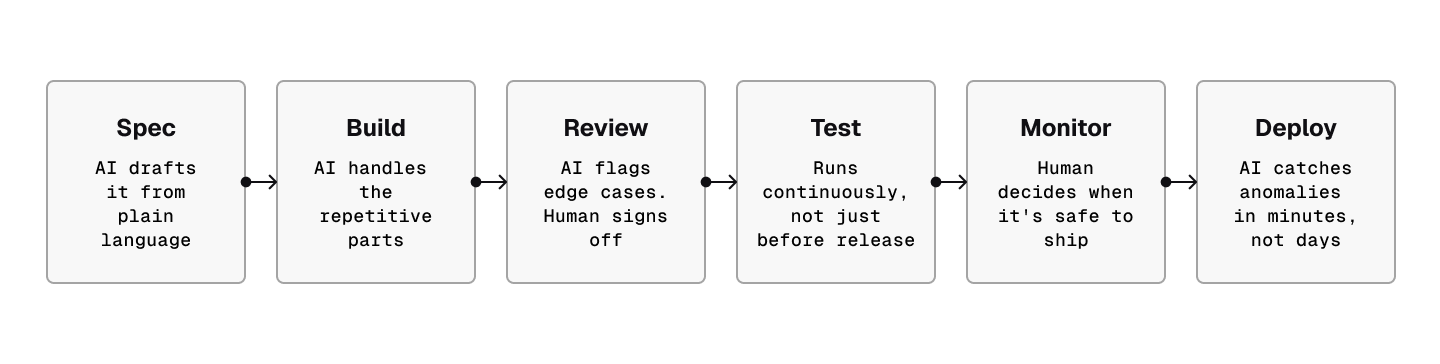
Spec → build → review → test → deploy → monitor
AI contributes at every stage, but the human is in charge of the decisions that actually require judgment, including what to build, whether the architecture holds up, if coverage is enough, when it’s safe to ship, and similar.
Wrapping Up
AI has changed how quickly teams can build software, but just because you can write more tests now, that doesn't automatically mean you’ll be confident in the end result. You need to look for the real warning signs, such as a test suite that nobody trusts anymore, a team re-running pipelines out of fear that something got missed, or bugs reaching production that your tests technically covered but nobody looked at closely.
If you’re considering implementing AI-based testing, take a moment to think. Who will check the results? What will happen if the product changes? What if it gets something wrong? Would anyone notice? These questions matter more than any feature list a vendor hands you. Without the right approach, you’ll just be relocating uncertainty probably to the one place you really want to avoid: production, after a customer has already found it.
That’s where continuous, agent-driven testing comes in.
Want to see what this looks like in practice? Book a demo with QA.tech and learn more.