Short answer: Copilot code review is good enough for most GitHub teams, and that's the problem with looking for an alternative: you'll find tools that comment more, or deeper, or cheaper per seat, and you'll still have a reviewer that reads the diff. Replace it if you're not on GitHub or the AI credits are getting expensive. Otherwise keep it and spend the budget on the check it can't do, which is running the pull request.
Copilot's real position: the floor
An engineering lead at a Nordic marketplace put it the way a lot of GitHub teams would. They run Copilot in GitHub, the review it produces works, and it's good enough. What he actually wanted was to have everything in the same system, not a better reviewer.
That's Copilot's position in 2026. If you're paying for Copilot Business at $19 a seat or Enterprise at $39, review is already in the box, metered on AI credits at roughly $0.05 to $1 per review on Lite effort and $0.25 to $5 on Balanced. Balanced routes complex, security-sensitive or cross-service PRs to a heavier model. It can run automatically on every push and on drafts if you turn that on, and an org ruleset can force it on regardless of personal settings.
Its limits are documented rather than hidden. It skips dependency manifests, lock files, logs and SVGs. GitHub's responsible-use page says it may highlight problems in reviewed code that do not exist. A consultancy that wrote up its experience with it found it a bit nitpicky and unaware of the business requirements. When we ran it on our own monorepo it read as a gentle assistant: good summaries, quiet on the line level, and at the time it refused to comment on one multi-package diff at all. It has matured since.
So the useful question is what Copilot isn't doing that you need.
Three reasons to switch, and where to go
You're not on GitHub. Copilot code review runs on GitHub, with Azure DevOps in public preview. On GitLab or Bitbucket your options are CodeRabbit ($24 to $72 per developer per month, all four major hosts), Qodo Merge (credit-priced at $0.012 a credit, all four hosts, with Gerrit and on-prem on Enterprise), Cursor Bugbot (about $1.00 to $1.50 a run, all four hosts), or Sourcery ($12 to $24 per developer, GitHub and GitLab).
You want depth Copilot doesn't give. Greptile indexes the whole repository and, in its TREX beta, writes and runs targeted tests in a sandbox during review. $30 per seat with 50 credits a month, and a free tier for one developer. Anthropic's Claude Code Review goes further on effort, running multiple agents over the diff and surrounding code at an average of $15 to $25 per review; it's in research preview for Claude Team and Enterprise plans, and its check never blocks a merge. CodeRabbit is the volume option: 50-plus linters and SAST tools run under the model, 72% relevant in one independent 28-PR count, with the rest as noise you'll triage.
The credits are adding up. Balanced-effort reviews at up to $5 each on a team opening a few hundred PRs a week start to look like a line item. Per-seat tools (CodeRabbit, Sourcery, Greptile) cap the exposure. Usage-priced tools (Bugbot, Qodo, Macroscope) don't, but may be cheaper per review.
Quick comparison
| Tool | Pricing (1 Oct 2026) | Hosts | Runs anything in review? |
|---|---|---|---|
| Copilot code review | AI credits per review + Copilot seat ($19/$39) | GitHub; Azure DevOps (preview) | No |
| CodeRabbit | $24–$72 per dev/month, annual | GitHub, GitLab, Bitbucket, Azure DevOps | Linters and analysis scripts, not your app |
| Greptile | $30 per seat + credits; free for 1 dev | GitHub, GitLab, Bitbucket, Gitea | TREX beta: tests in a sandbox |
| Qodo Merge | $0.012/credit packs; no free tier | GitHub, GitLab, Bitbucket, Azure DevOps | No |
| Cursor Bugbot | ~$1.00–$1.50 per run | GitHub, GitLab, Bitbucket, Azure DevOps | No |
| Claude Code Review | ~$15–$25 per review, research preview | GitHub | Verification against code; test execution not documented |
| QA.tech PR testing | Metered on test executions; Growth and Enterprise | GitHub, GitLab; others via API | Yes: runs the deployed PR, mobile build or API |
What Copilot and every other reviewer skip
The right-hand column of that table tells the story: one tool runs tests it wrote itself in a sandbox, the other reviewers read, and only the last row deploys the branch and uses it. That isn't a gap in Copilot so much as the edge of the category. A reviewer answers whether the code is written well. It can't answer whether a user can still complete the flow the code is part of, because that question needs a running product, a browser, and someone or something clicking through the change. Vilhelm von Ehrenheim, QA.tech's co-founder and Chief AI Officer, still wants a human in the loop on every merge. His point is that at agent-scale PR volume the human can't read every line, so the PR needs enough collected evidence that a quick look is a confident one.
The evidence that review alone doesn't find the bugs predates AI: the 2015 Microsoft Research study of its own review comments found about 15% pointed at a possible defect; the rest was maintainability and understanding. And the pressure is now on the other side of the equation. Faros found median PR review time five times longer on teams with high AI adoption than on low-adoption teams. At GOTO Copenhagen on 1 October, a live poll during Nathen Harvey's DORA keynote asked 440 people which stage of their delivery process causes the most friction, and half picked reviewing changes. We were in the room and wrote it up in why code review is eating your AI gains.
A director of engineering at a cloud-security company described exactly the setup this page is about: they're on GitHub, they already have Copilot, their front-end team has one of the most careful manual review processes he's seen, and their version number still jumps 30 to 50 times per test cycle. What he wanted wasn't another reviewer but something that fits into that flow, checks the product, and that his reviewers wouldn't see as another road bump.
Add the second gate instead
QA.tech's dynamic PR testing is designed to sit beside Copilot on the same PR. On open, the agent reads the PR description, linked Jira or Linear ticket, changed files and commits, classifies the change, selects existing tests for the affected flows and creates one to three new ones only where there's a gap, runs them against the preview deployment, and posts a native GitHub review: approve, request changes or comment, with a results table. The review carries no code quality opinions and no references to other bot comments, so it doesn't duplicate or argue with Copilot. A QA.tech / PR Review check can be required in branch protection, which is a gate Copilot's review can't be.
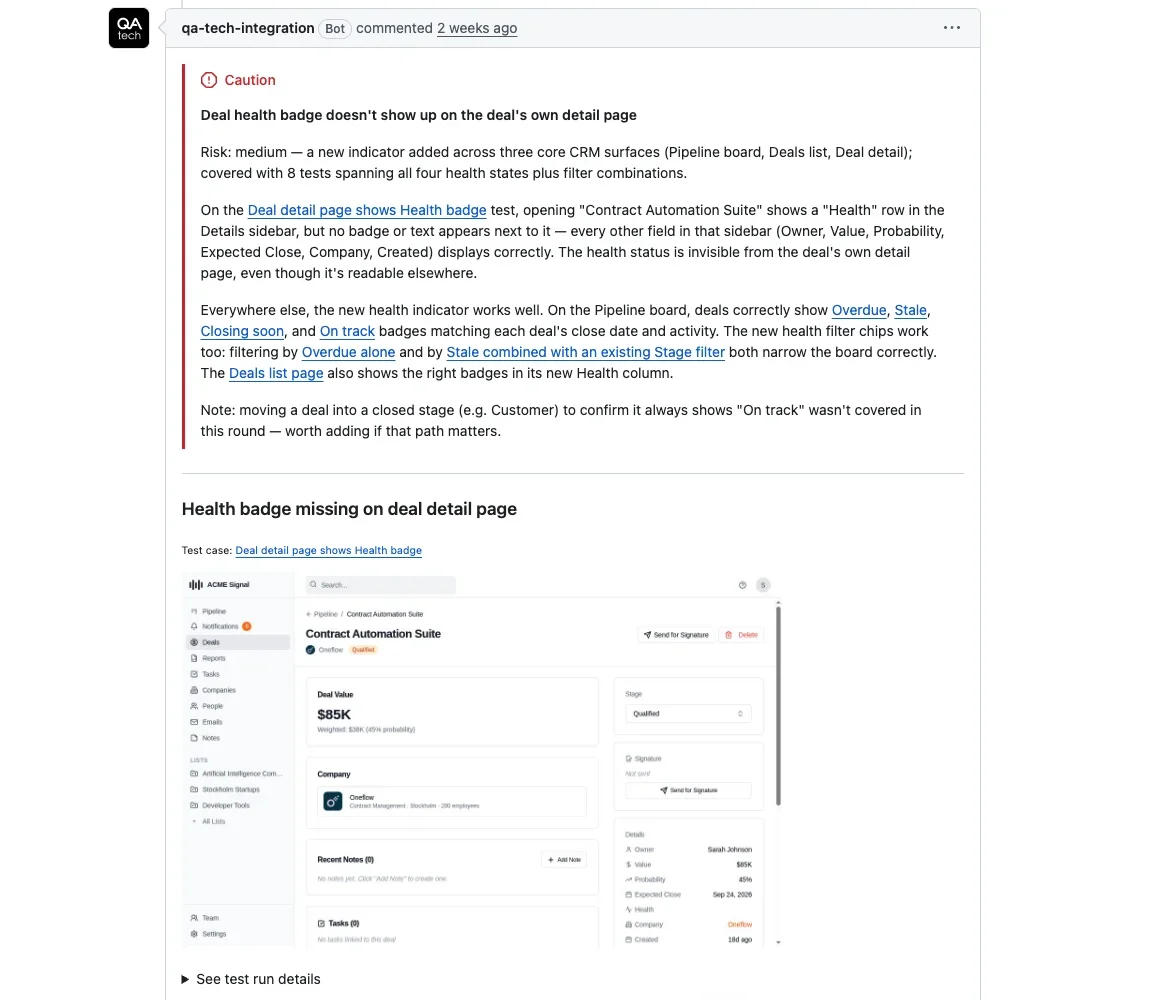
What the review looks like on the PR. This one is from a pull request on our demo CRM: the new health badge worked on the pipeline board and the deals list, and was missing on the deal's own detail page. A diff reviewer had no way to see that.
Tests that ran but didn't exercise the change come back unverified rather than green. Preview deployments on Vercel, Netlify, Render, Railway or Fly.io are detected automatically; anything else publishes a GitHub Deployment with a URL. No previews at all? Run the review after merge against staging and the result posts back on the merged PR.
Copilot is already paid for, so keep it and add the verifier; the human who merges then gets a diff review and a product result in the same thread.
Also in this series: CodeRabbit alternatives, Qodo alternatives, Cursor Bugbot alternatives and Greptile alternatives.