Short answer: The teams we talk to about a CodeRabbit alternative want one of three things: fewer comments, a bill that isn't per seat, or a reviewer that catches the bugs CodeRabbit missed. The first two have good answers below. The third needs a different kind of tool, because every code reviewer on this list reads the diff the same way CodeRabbit does. The one entry that doesn't is the one that opens the app.
Why teams go looking
CodeRabbit is the most adopted tool in its category, and the complaints about it are the complaints you'd expect from a tool that comments a lot. One open-source maintainer who ran it on 28 pull requests counted 290 findings, of which 72% were relevant. That's a good hit rate for a bot, and on a busy repo the remainder still adds up to a lot of threads someone has to close.
Price is the second reason. CodeRabbit charges per developer: $24, $48 or $72 a month depending on plan, billed annually, with hourly review caps of 5, 8 or 10 per developer (checked 1 Oct 2026). A team of 30 on the middle plan is paying about $17,000 a year for review comments, whether or not everyone opens a PR that month.
The third reason is the one we hear most, and it has nothing to do with CodeRabbit specifically. In our own test of CodeRabbit on a monorepo, it was strong on style and standards and silent on an empty-input edge case our human reviewers caught. The comparisons we read for this piece, Greptile's benchmark and Macroscope's alternatives page among them, name the same misses: business logic, race conditions, authorisation flows. None of those is visible in a diff; they show up when someone clicks through the change.
The six alternatives people compare
These are the tools that show up in the same searches and the same Reddit threads, with pricing from each vendor's own page on 1 Oct 2026. Check them again before you buy; this category reprices every few months.
Greptile is the one most often picked for "catches more". It indexes the whole repository rather than the diff, and since June 2026 it has a beta mode called TREX that writes and runs targeted tests in a sandbox. Pricing is $30 per seat per month with 50 review credits per seat, a free tier for one developer, and $1 per extra credit. Base reviews cost 1 credit, deeper tiers 3 or 10. Worth knowing: Greptile's own benchmark page scores CodeRabbit at 44% and itself at 82% on 50 planted bugs across five repos. It's a vendor-run test, so treat the number accordingly.
Cursor Bugbot fits teams already in Cursor. It's quieter than CodeRabbit by design and bills per run instead of per seat: an average review costs $1.00 to $1.50 under the usage billing Cursor announced in May 2026 to replace the old $40 flat fee. Works on GitHub, GitLab, Bitbucket and Azure DevOps. If your reviewers live in a different editor, the "Fix in Cursor" buttons are wasted on them.
GitHub Copilot code review is the floor. If you pay for any paid Copilot plan (Business is $19 per seat, Enterprise $39), review is already there, metered in AI credits at roughly $0.05 to $1 per review on Lite effort and $0.25 to $5 on Balanced, plus Actions minutes for the agentic steps. GitHub, with Azure DevOps in public preview. The usual knock is that it's nitpicky and doesn't know your business rules, which is true of every reviewer here and more forgivable at this price.
Qodo Merge is the open-source-rooted option. It grew out of PR-Agent and bills on credits at $0.012 each, in packs of 2,500 to 20,000 a month, with a 14-day trial and no permanent free tier. On-prem and air-gapped deployment exist on Enterprise. Note that the test-generation side of Qodo, the Qodo Cover project, has been unmaintained since June 2025, so the pitch today is review and remediation, not tests.
Graphite bundles review into a stacked-PR workflow. If you already use Graphite to split big changes into chains of small PRs, unlimited AI review is included on the Team plan at $40 per user per month. GitHub only. Buying it for the review alone makes less sense than buying it for the stacking.
Macroscope is the usage-priced newcomer with its own "CodeRabbit alternatives" page. Its own comparison claims it comes in about 40% below CodeRabbit on an equivalent month of reviews. There's no public rate card, so treat that as a claim to test with the $100 trial credit.
Also in the running, for completeness: cubic ($40 per developer), Sourcery ($12 to $24 per developer, annual), Bito, CodeAnt, Kilo. And the two that matter most for where this is heading: Anthropic's Claude Code Review, in research preview for Team and Enterprise plans at an average of $15 to $25 per review, and OpenAI's Codex review, included with ChatGPT Plus, Pro, Business, Edu and Enterprise. With the model vendors shipping review as a feature, the pricing above will look different a year from now.
Quick comparison
| Tool | Pricing model (1 Oct 2026) | Platforms | Runs anything? |
|---|---|---|---|
| CodeRabbit | $24–$72 per developer/month, annual | GitHub, GitLab, Bitbucket, Azure DevOps | Linters and analysis scripts in a sandbox; not your app or your test suite |
| Greptile | $30 per seat + credits; free for 1 dev | GitHub, GitLab, Bitbucket, Gitea | With TREX (beta): writes and runs tests in a sandbox |
| Cursor Bugbot | ~$1.00–$1.50 per run | GitHub, GitLab, Bitbucket, Azure DevOps | No |
| Copilot code review | Included in paid Copilot plans, AI credits per review | GitHub; Azure DevOps (preview) | No |
| Qodo Merge | $0.012 per credit, packs | GitHub, GitLab, Bitbucket, Azure DevOps | No |
| Graphite | $40 per user/month (Team) | GitHub | No |
| Macroscope | Usage-based, no public rates | GitHub | No |
| QA.tech PR testing | Metered on test executions, not developer seats; Growth and Enterprise plans | GitHub, GitLab; Bitbucket, Azure DevOps and others via API | Yes: runs the deployed PR through the UI, mobile build or API |
The gap every reviewer on this list shares
You can swap CodeRabbit for any reviewer in the table and you will have changed the comment volume, the price and maybe the hit rate. You will not have changed what gets checked. A reviewer, human or AI, is reasoning about text. Whether the checkout still completes after the change, whether the login redirect works on mobile, whether the new permission check locks out the admin, those are questions about a running product, and no amount of reading answers them.
Vilhelm von Ehrenheim, QA.tech's co-founder and Chief AI Officer, put it in one line: the reviewer reads the diff, a verifier runs the product. A code review agent is still worth having, he said, because it finds the stuff that's bad practice in general, like API keys committed to the repo. It just answers a different question from "does this work".
This is an old finding dressed in new tools. Microsoft Research looked at review comments across its own teams in 2015 and titled the paper Code Reviews Do Not Find Bugs: about 15% of reviewer comments pointed at a possible defect, and at least half were about long-term maintainability. AI review has made that feedback faster and cheaper to produce without changing what kind of feedback it is.
Meanwhile the volume problem that sent you looking for a CodeRabbit alternative is getting worse on the other side. Faros compared teams with high and low AI adoption and found median PR review time five times longer on the high-adoption side. At GOTO Copenhagen this week, a live poll during Nathen Harvey's DORA keynote asked 440 people which stage of their delivery process causes the most friction, and half picked reviewing changes; we were in the room, and we've written that session up in why code review is eating your AI gains. An engineering lead at a staffing platform in Europe told us one of his engineers is reviewing ten pull requests a day on a codebase that is now more than 80% AI-generated. A faster reviewer helps him read faster, and still doesn't tell him which of the ten actually work.
What to add instead of what to swap
We'd rather you kept CodeRabbit, or picked whichever reviewer above suits your stack, and added the thing none of them do.
Dynamic PR testing is QA.tech's name for it. When a pull request opens, the agent reads the PR description, linked Jira or Linear ticket, changed files and commits, in that order, classifies whether the change is user-facing, picks the existing tests that cover the affected flows and creates one to three new ones only where there's a gap. Then it runs them against the PR's preview deployment and posts a native GitHub review: approve, request changes or comment, with a results table. A QA.tech / PR Review check lands on the commit, and you can require it in branch protection as a merge gate. If the tests ran but never actually exercised your change, you get an unverified verdict rather than a false green.
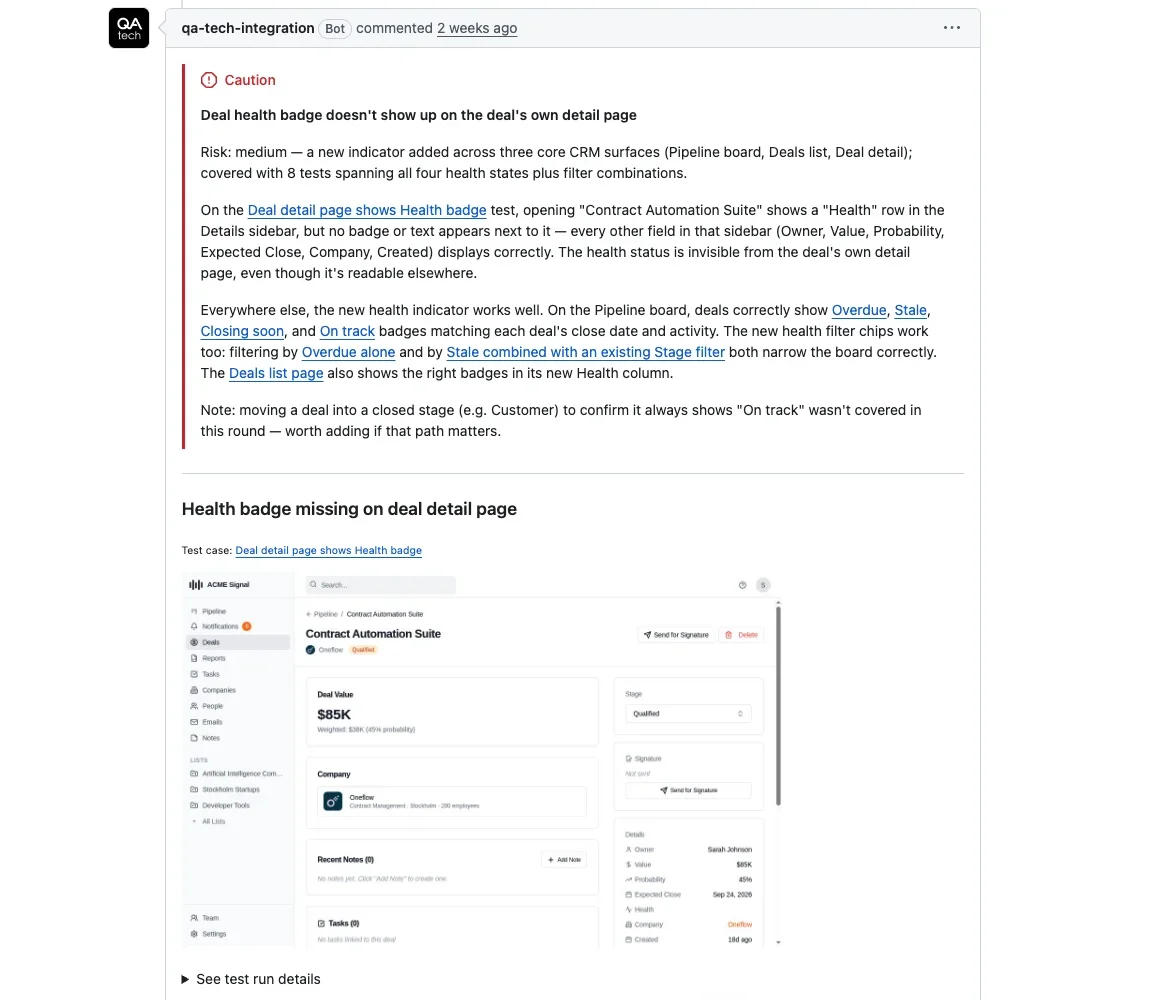
What the review looks like on the PR. This one is from a pull request on our demo CRM: the new health badge worked on the pipeline board and the deals list, and was missing on the deal's own detail page. A diff reviewer had no way to see that.
The review itself carries no code quality opinions and no references to other bot comments. That's deliberate, because CodeRabbit already has that thread and this one only says whether the product still works.
It runs on GitHub and GitLab, and from Bitbucket, Azure DevOps, CircleCI or Jenkins through the change review API. No preview environment? Run it after merge against staging, and the results post back on the merged PR.
An ed-tech team we spoke to in July runs Claude Code and Codex for development and CodeRabbit for review, and was clear about what the review step leaves open: it isn't enough that something says the case failed, the failure has to go back to the agent with the where and the why. That's the loop we recommend: reviewer on the text, verifier on the product, both posting to the same PR.
If there's budget for only one, keep the reviewer; it's cheap and it catches the committed API key. When there's budget for a second gate, price it against the last bug that reached production.
Also in this series: Qodo alternatives, Cursor Bugbot alternatives, GitHub Copilot code review alternatives and Greptile alternatives.