
Can an AI reviewer save us time and improve code quality in our workflow? To find out, we pitted several AI PR review tools against each other in a real-world scenario – and in this 2026 update, we've expanded the list to ten tools, because the market has exploded since we ran our original test. Code reviewers are one kind of AI verifier agent; the running product needs its own.
Before we dive in: I code well, but I write like a donkey – so I used AI to turn our hands-on research into an easy-to-read blog post.
Key takeaways
- We tested four AI code reviewers hands-on in our production monorepo: CodeRabbit, devlo, GitHub Copilot, and Ellipsis. Ellipsis won on signal-to-noise.
- Six more tools have earned a place on the 2026 shortlist: Qodo Merge, Greptile, Graphite, Cursor Bugbot, CodeAnt AI, and Bito.
- Every tool on this list reads your diff. None of them run your application – which is why teams shipping with coding agents pair a code reviewer with PR testing.
Our test environment was a Vercel Turborepo-based monorepo that contains a bit of everything – TypeScript packages, React applications (with ShadCN UI components and Tailwind CSS), and even a Python app. We weren't just interested in if these tools work, but how they handle the quirks of a real codebase. Do they nitpick formatting or actually catch tricky bugs? Are they helpful sidekicks or noisy backseat drivers?
Part one covers the four reviewers we ran on our own pull requests: CodeRabbit, devlo, GitHub Copilot, and Ellipsis (YC W24). Part two rounds up six more tools worth evaluating in 2026. And part three covers the half of the PR gate that none of these tools touch. (Don't worry – we'll keep it technical, but with a dash of humor. Even code review bots appreciate a good dad joke now and then.)
Part 1: The four AI code reviewers we tested hands-on
After running these tools on several PRs, we gathered some high-level impressions of each. Here's how CodeRabbit, devlo, Copilot, and Ellipsis fared in our monorepo showdown.
CodeRabbit
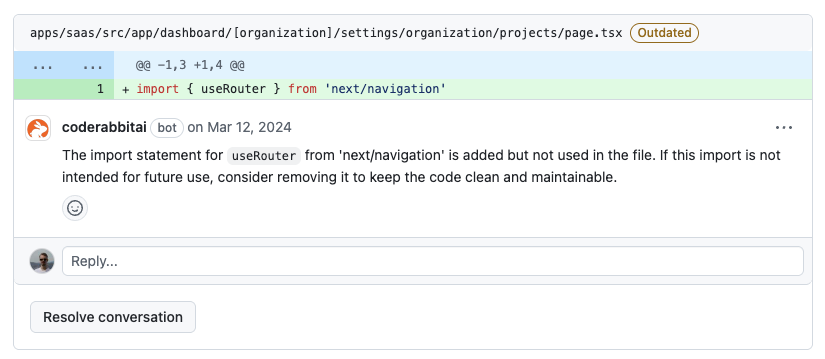
CodeRabbit made a strong first impression when it came to enforcing code standards and style consistency. It diligently pointed out lint issues, formatting inconsistencies, and naming deviations. In a way, it felt like an automated ESLint+Prettier on steroids – if a variable name didn't match our conventions or a file's structure was off, CodeRabbit caught it. This was great for keeping our TypeScript/React code style on point.
However, CodeRabbit showed some weakness in catching deeper implementation bugs. It occasionally missed logical errors or subtle bugs in the code's logic. For example, in one PR a function's edge case (handling an empty input) was flawed – our human reviewers caught it, but CodeRabbit was oddly silent, having been more concerned about a missing JSDoc comment. It seems CodeRabbit stays within the lines of the PR diff and focuses on what it can easily lint. If a potential issue involved understanding context outside the PR or a cross-module interaction, it often glossed over it.
Worth noting for 2026: CodeRabbit remains one of the most widely adopted reviewers in the category, with broad platform support across GitHub, GitLab, Bitbucket, and Azure DevOps, and it has kept adding features at a steady pace since our test. If you're weighing CodeRabbit alternatives, we've compared the six tools people switch to and what none of them change.
Bottom line: great for polish, consistency, and easy adoption, but don't expect it to be a full-fledged bug detective.
devlo
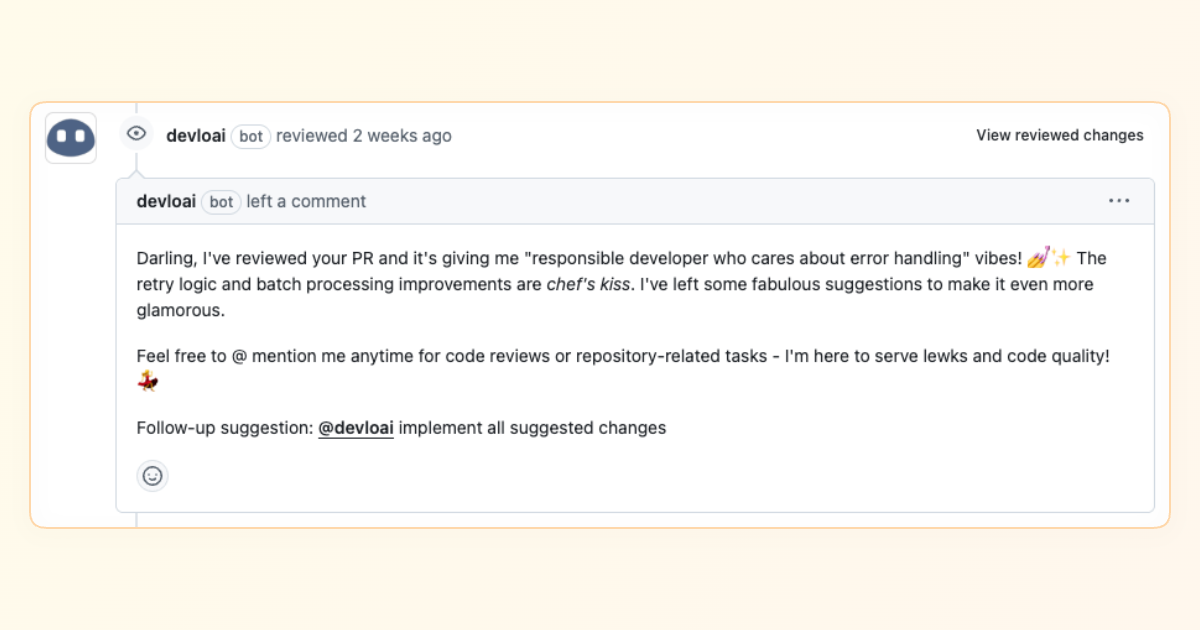
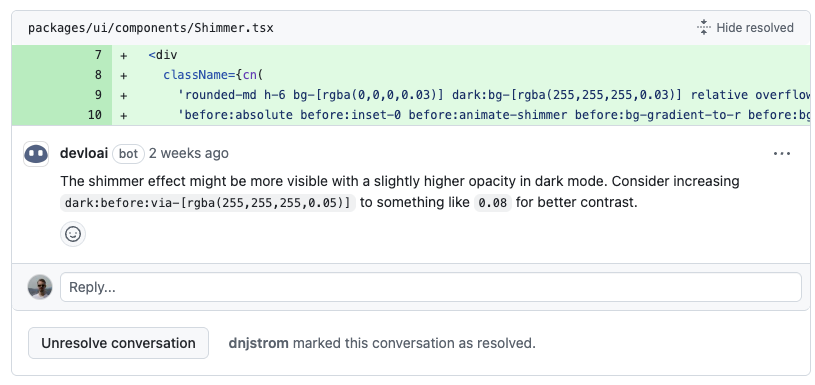
The devlo AI reviewer was like an enthusiastic teammate who had just finished a software architecture course. It provided insightful suggestions – often going beyond surface-level comments. In several instances, devlo not only flagged a potential problem but also suggested a clever solution or a best practice. For instance, it spotted an inefficient loop in our Python module and suggested using a generator for better performance. These kinds of value-added comments made us feel like devlo was really reading and understanding our code, not just pattern-matching common issues.
The flip side was that devlo could be noisy with excessive comments. It had a lot to say... about everything. Minor issues, stylistic preferences, even things that were arguably subjective got comments. Our PR discussion threads sometimes doubled in length due to devlo's running commentary. We found ourselves sifting through a wall of AI comments to find the one or two truly important suggestions. It felt like having a hyperactive intern – eager to help but pointing out the obvious along with the insightful. We occasionally responded with, "Thanks, devlo, we'll consider that," while secretly rolling our eyes at a comment about an extra newline.
Bottom line: devlo's feedback was a mixed bag – very useful gems buried in a lot of well-intentioned noise.
GitHub Copilot (PR Reviews)
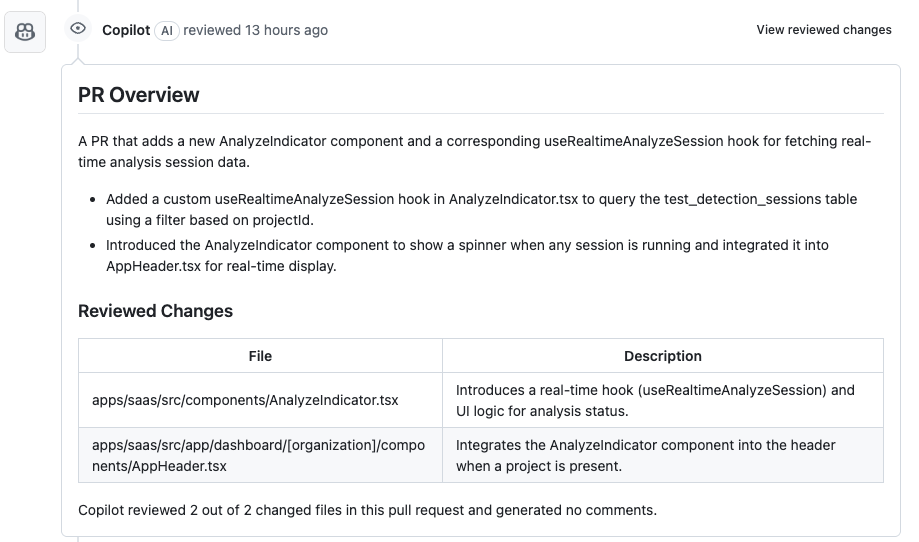
We also experimented with GitHub Copilot's pull request review features. Unlike CodeRabbit and devlo, Copilot's approach felt more like a gentle assistant than an overly eager reviewer. It typically produced fewer comments overall, focusing on only the most relevant points. Its hallmark was delivering an excellent summary of the PR. For each pull request, Copilot would generate a succinct description of what changed – highlighting key modifications (e.g. "Added new validation for email input in UserForm component" or "Refactored the authentication middleware in the Python app"). This summary was pure gold for quickly understanding a large PR without reading every line.
When it came to detailed line-by-line feedback, Copilot was relatively quiet. It flagged only obvious issues, leaving the nitpicks aside. This minimalist approach meant less noise, but also that Copilot might overlook improvements the specialist tools would comment on. At the time of our original test, we also hit automation challenges – summaries were flaky to trigger, and in one case Copilot simply refused to comment on a multi-package diff in our monorepo.
A fair 2026 update: Copilot code review has matured considerably since then. It now ships as part of Copilot at the organization level, which makes it the zero-friction baseline for any team already paying for Copilot. If you already have it, our GitHub Copilot code review alternatives page covers the three cases where replacing it makes sense, and what to add otherwise. Depth still trails the specialists, but as a default first pass it has become table stakes.
Bottom line: a high-level PR assistant, great for summaries and light feedback. Use it as the floor and layer a specialist on top for high-stakes repos.
Ellipsis (YC W24)
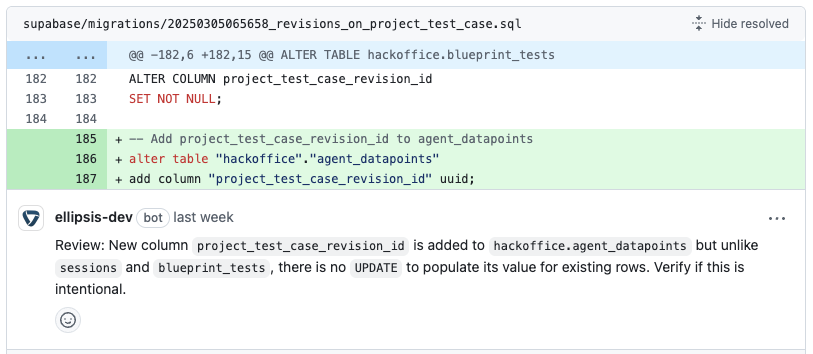
Ellipsis was ultimately the best performer in our tests. Right out of the gate, its feedback quality was impressive. It seemed to filter out unhelpful suggestions and avoid commenting just for the sake of it. When Ellipsis left a comment, it was usually on point – either identifying a potential bug, a logic oversight, or a meaningful improvement. For example, Ellipsis caught a tricky state management bug in our React app that none of the other AI tools (nor one of our humans!) caught initially. That earned it some real street cred with the team.
We also noticed that Ellipsis adapted to our feedback and guidelines over time. We had a few custom rules (like allowing certain TODO comments, or using specific TypeScript utility types) that initially triggered some comments. But after we dismissed a couple of those, Ellipsis learned – subsequent PRs saw fewer irrelevant comments. It was almost as if it was tuning itself to our codebase's personality.
The comment quality was uniformly high. Ellipsis's comments read like a seasoned developer's review: clear, concise, and with context. Instead of just "This is wrong," it would say "This check will fail for empty arrays – consider handling that case to avoid a runtime error." That kind of guidance is invaluable. It even provided occasional links to documentation when pointing out less obvious issues.
The favorite: why Ellipsis stood out
After weeks of dogfooding these AI tools, Ellipsis (YC W24) emerged as the clear favorite for our team. So, what made Ellipsis shine brighter than the rest?
1. Focused reviews. Ellipsis has an almost human-like judgment on what's important. It doesn't bother us with trivial style points if our existing linters already handle them. Instead, it hones in on things that impact bug risk, logic, or maintainability. One developer noted, "Ellipsis's comments feel like they came from a tech lead, not a lintern" – by which he meant a linter turned up to 11.
2. Adaptability. Perhaps the most impressive aspect was how Ellipsis learned from our interactions. We have a unique mix of frontend (React + ShadCN/Tailwind) and backend (Python FastAPI) code. Early on, we gave Ellipsis feedback by dismissing a couple of comments. To our surprise, similar suggestions didn't appear in later reviews. It felt like training a smart junior dev: once we said "hey, in our repo we do XYZ this way," Ellipsis remembered.
3. Quality of feedback. The feedback from Ellipsis wasn't just accurate – it was actionable and well-articulated. Comments often included reasoning or even pseudo-code for a fix. In a PR refactoring our authentication logic, Ellipsis pointed out a potential race condition and suggested using an async lock, with a short code snippet to illustrate. It didn't just say "possible bug here"; it told us the what and the why.
4. Workflow improvement. With Ellipsis in our GitHub workflow, our PRs got merged faster and with more confidence. It acts like a tireless first-pass reviewer, so human reviewers could focus on design decisions instead of combing through for small bugs. Because it so rarely cried wolf, we paid attention when it spoke up. One teammate joked that Ellipsis deserved an "Employee of the Month" award, if only it had a GitHub profile picture to put on the plaque.
Part 2: Six more AI code reviewers worth evaluating in 2026
Our hands-on test covered four tools, but the category has grown fast. These six come up most often in 2026 evaluations, each with a distinct angle. We haven't dogfooded them the way we did the four above, so treat these as a shortlist for your own trial rather than a verdict.
Qodo Merge
Built on the open-source PR-Agent project, Qodo Merge works through commands in your PR thread – /review, /describe, /improve, /ask – which makes it interactive rather than one-shot. We've also written up Qodo alternatives, including what happened to Qodo Cover and PR-Agent. Its rule system lets teams encode engineering standards centrally and enforce them across repositories, and it can be fully self-hosted. Strong fit for teams with strict PR templates, ticket-compliance requirements, or security policies that rule out hosted-only tools.
Greptile
Greptile's angle is whole-repository context: it indexes your entire codebase rather than just the diff, so it can surface cross-file regressions that line-level reviewers miss. Its TREX beta goes further and runs tests in a sandbox; our Greptile alternatives page covers what that does and doesn't check. That makes it a natural fit for large monorepos where bugs hide between modules. It moved to usage-based pricing in early 2026, which stirred some community debate, and it added a free tier mid-year. If cross-file bug catching is your failure mode, it belongs on your shortlist.
Graphite
Graphite is a PR workflow product first – built around stacked diffs, breaking large changes into small dependent PRs that merge in sequence – with AI review layered on top. If your team already works in stacks or wants to, getting review and workflow from one tool is the draw. If you just want a reviewer bolted onto vanilla GitHub flow, the workflow opinionation may be more than you need.
Cursor Bugbot
For the growing number of teams writing code in Cursor, Bugbot extends the same ecosystem to PR review, including an autofix capability that proposes patches for the issues it finds. Fixes still need human validation before merge, and it's billed by usage on top of a Cursor subscription, so evaluate the total cost. Teams that aren't fully on Cursor can compare Cursor Bugbot alternatives that work from any editor. The appeal is consolidation: one vendor from code generation through review.
CodeAnt AI
CodeAnt combines code review with security scanning in one pass – flagging quality issues alongside vulnerabilities, secrets, infrastructure-as-code misconfigurations, and dependency risks, with one-click fixes suggested in the PR. It connects to GitHub, GitLab, Bitbucket, and Azure DevOps. A sensible pick if you'd otherwise run a reviewer and a separate SAST tool and would rather consolidate.
Bito
Bito leans into IDE integration and a security-first review posture, with its agentic review engine focused on cutting false positives – the noise problem we hit with devlo is exactly what it markets against. Teams that want review feedback inside the editor as well as on the PR, and that operate in regulated environments, are its core audience.
Part 3: Code review is half the PR gate
Every tool above reads your diff. None of them open your app.
A code reviewer can approve a pull request that still breaks checkout, because static analysis never sees what happens when a real user clicks through the change. The teams we talk to feel this gap most right after adopting coding agents: Claude Code and Codex push PR volume from a handful a week to 50 or 100, code review scales with an AI reviewer, and testing becomes the one gate still running at human speed. At GOTO Copenhagen this October, half of 440 engineers named reviewing changes as their biggest SDLC bottleneck, and we have written up why code review is eating your AI gains. If you're closing that gap, start with our roundup of the best agentic QA tools in 2026.
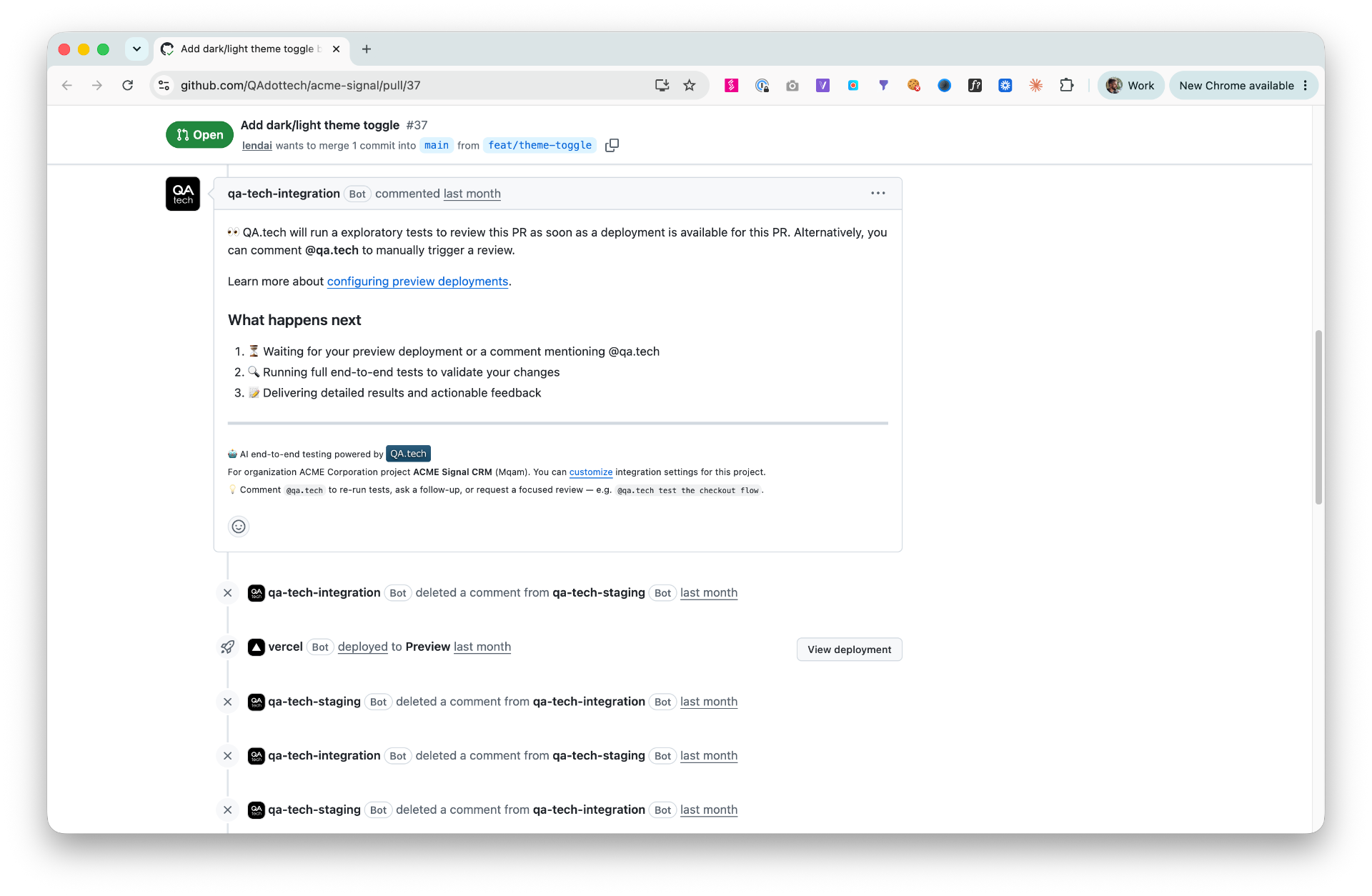
That is the half QA.tech covers. PR testing runs QA agents against the preview deployment of every pull request – the agents pick up the PR from GitHub, run regression and exploratory tests through the real UI, and post pass/fail results back to the PR before review starts. Because the agents test by goal rather than by script, the tests hold up even when the diff renames components or reworks the layout.
The two layers complement each other. An AI code reviewer like Ellipsis or CodeRabbit tells you whether the code is well written. QA agents tell you whether the product still works. Teams shipping with coding agents increasingly run both on every PR: one gate for the diff, one for the deployment.
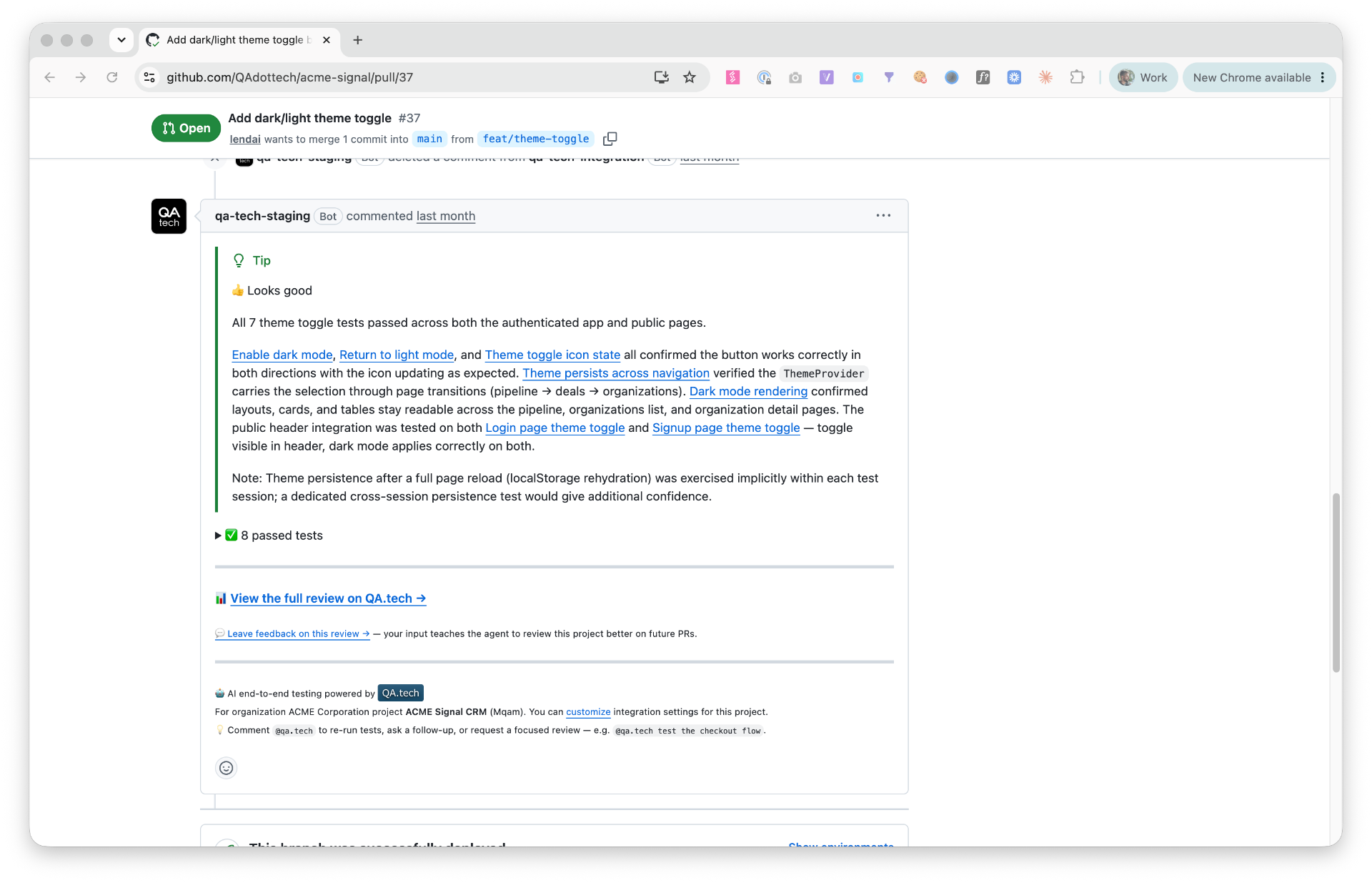
If you want to see what that looks like on your own repository, connect GitHub and run it on your next PR.
Conclusion
In the end, introducing AI into our code review process proved to be a net positive. We caught issues we might have missed, saved senior developers some time, and even learned a few best practices along the way. The key was finding the right balance: using AI feedback as a guide, not gospel. Human reviewers still have the final say, but now they have a helpful AI sidekick watching their back.
In all seriousness, our experience showed us that AI's role in code review is like a competent junior developer: it speeds things up, asks good questions, and yes, sometimes it really needs a coffee break (looking at you, devlo, with those 117 comments on a 5-file PR).
And once the diff is reviewed, remember there's a second question every PR should answer: does the product still work? That one takes QA agents, not a code reviewer.
If your team runs Playwright today, here is how QA.tech compares with Playwright.