Short answer: If you're leaving Qodo Merge, the two reasons we hear are these: the credit pool ran out faster than the sales call suggested, or you came for the test generation and found that Qodo Cover is no longer maintained. The five reviewers below fix the first. The second takes something that isn't a reviewer at all, and it's the last row of the comparison.
What Qodo is in 2026, briefly
Qodo started life as CodiumAI, with two products people still conflate. Qodo Merge is the PR reviewer, descended from the open-source PR-Agent. Qodo Gen was the IDE plugin that generated tests and code, and Qodo Cover was the CLI that generated tests and ran them until coverage went up.
Two of those three have changed shape. Qodo's docs now say the company is deprecating its code generation features, and the plugin has been renamed to focus on local review. The Qodo Cover repository carries a notice dated 15 June 2025: this repository is no longer maintained. PR-Agent is still MIT-licensed and still on GitHub, but Qodo describes it as a community-maintained legacy project, not the open-source offering.
So what's left to buy is a reviewer with a remediation agent that opens fix PRs, priced on credits at $0.012 each in monthly packs of 2,500, 5,000 or 20,000, which Qodo says is roughly 18, 36 or 144 reviews (checked 1 Oct 2026). There's a 14-day trial and, in Qodo's own words, no permanent free tier. Larger PRs draw more credits. Qodo's pricing page says so in one line; read it before you size the pack.
One more line from the docs worth reading before you let the remediation agent loose. Qodo recommends reviewing and validating outputs before use, and advises against using these features in production or business-critical workflows. Nothing runs the fix PR before it's opened; it's generated from the finding.
Five alternatives, with today's numbers
CodeRabbit is the category default and the first name on most shortlists. $24, $48 or $72 per developer per month, billed annually, with a layer of 50-plus linters and security tools under the LLM. It comments a lot. An independent maintainer who ran it over 28 PRs found 72% of 290 findings relevant, which is good and also means a quarter of the threads were nitpicks.
Greptile is the pick if your complaint was depth, not price. Whole-repo indexing, $30 per seat per month with 50 credits per seat and a free tier for a single developer. Its TREX beta, out since June, writes and runs targeted tests in a sandbox, which makes it the closest thing on this list to what Qodo Cover used to do.
Cursor Bugbot is the usage-priced one, and the contrast with Qodo's packs is the point. Cursor's own average is about $1.00 to $1.50 a run, announced in May with existing customers moving over at renewals after 8 June. It's deliberately sparse with comments and runs on GitHub, GitLab, Bitbucket and Azure DevOps, with Fix in Cursor links that only matter if your team writes in Cursor.
GitHub Copilot code review if you're on GitHub and already paying for Copilot. $0.05 to $1 of AI credits per review on Lite, $0.25 to $5 on Balanced, on top of the $19 Business or $39 Enterprise seat. GitHub's own responsible-use page says it may highlight problems in reviewed code that do not exist. That caveat applies to every reviewer on this list.
Sourcery costs the least per seat of anything credible here and still gives you a merge gate: $12 per developer per month on Pro, $24 on Team, annual. GitHub and GitLab including self-managed on every plan, and it posts a status check called Sourcery review that can gate merges. It skips draft PRs and dependency-bot PRs by default.
If self-hosting was the reason you picked Qodo, the realistic replacements are CodeRabbit Enterprise (500-seat minimum for self-hosted), Greptile Enterprise, or running the legacy PR-Agent yourself.
Quick comparison
| Tool | Pricing (1 Oct 2026) | Self-hosted | Executes anything in review? |
|---|---|---|---|
| Qodo Merge | $0.012/credit, packs; no free tier | Yes (Enterprise, on-prem, air-gapped) | No |
| CodeRabbit | $24–$72 per dev/month, annual | Enterprise, 500+ seats | Linters and analysis scripts; not your app |
| Greptile | $30 per seat + credits; free for 1 dev | Enterprise | TREX beta: writes and runs tests in a sandbox |
| Cursor Bugbot | ~$1.00–$1.50 per run | No | No |
| Copilot code review | AI credits per review on top of Copilot seat | No | No |
| Sourcery | $12–$24 per dev/month, annual | Enterprise | No |
| QA.tech PR testing | Metered on test executions; Growth and Enterprise plans | No (cloud) | Yes: runs the deployed PR, mobile build or API |
The job none of the reviewers do
Every Qodo alternatives page, this one included, compares comment quality, price, platforms, and whether there's a fix button. It never covers what happens after the comment is resolved, which is that the PR merges and someone finds out in staging whether the feature works.
Qodo Cover was reaching for something real, tests that only exist because the change does, and a generated unit test still only checks the function in isolation. What the team on the other end of the PR actually wants to know is whether the user can still check out, still log in, still see their dashboard after the change. The only way to answer that is to deploy the branch and try it.
Vilhelm von Ehrenheim, QA.tech's co-founder and Chief AI Officer, says the first thing to fix is preview environments on every PR, because without one nothing can run the product and every check is a reading of the code.
The pressure to do this is coming from PR volume, not from tooling preferences. A product and engineering team at a mid-size SaaS company told us their releases went from about 15 PRs to 150 or 200 after adopting coding agents, with the same QA headcount, and described each production push as rolling a sketchier dice. A B2B SaaS team said PR volume tripled in Q1 and doubled again in Q2 against two QA staff. Those teams need something that checks the product at the speed the PRs arrive.
What a verifier on the PR looks like
QA.tech's dynamic PR testing is built for exactly that slot, next to whichever reviewer you keep. The part Qodo Cover never had is the input: the agent starts from the PR description and linked ticket, not from a function signature, then picks the existing flow tests the change touches and writes one to three new ones only if nothing covers it. It runs them against the preview deployment and posts a native review with a verdict, a results table and the evaluation. Tests created in a review start as drafts, kept out of your test list, and on GitHub a post-merge agent can promote the useful ones into the regression suite afterwards. Most PRs create zero new tests.
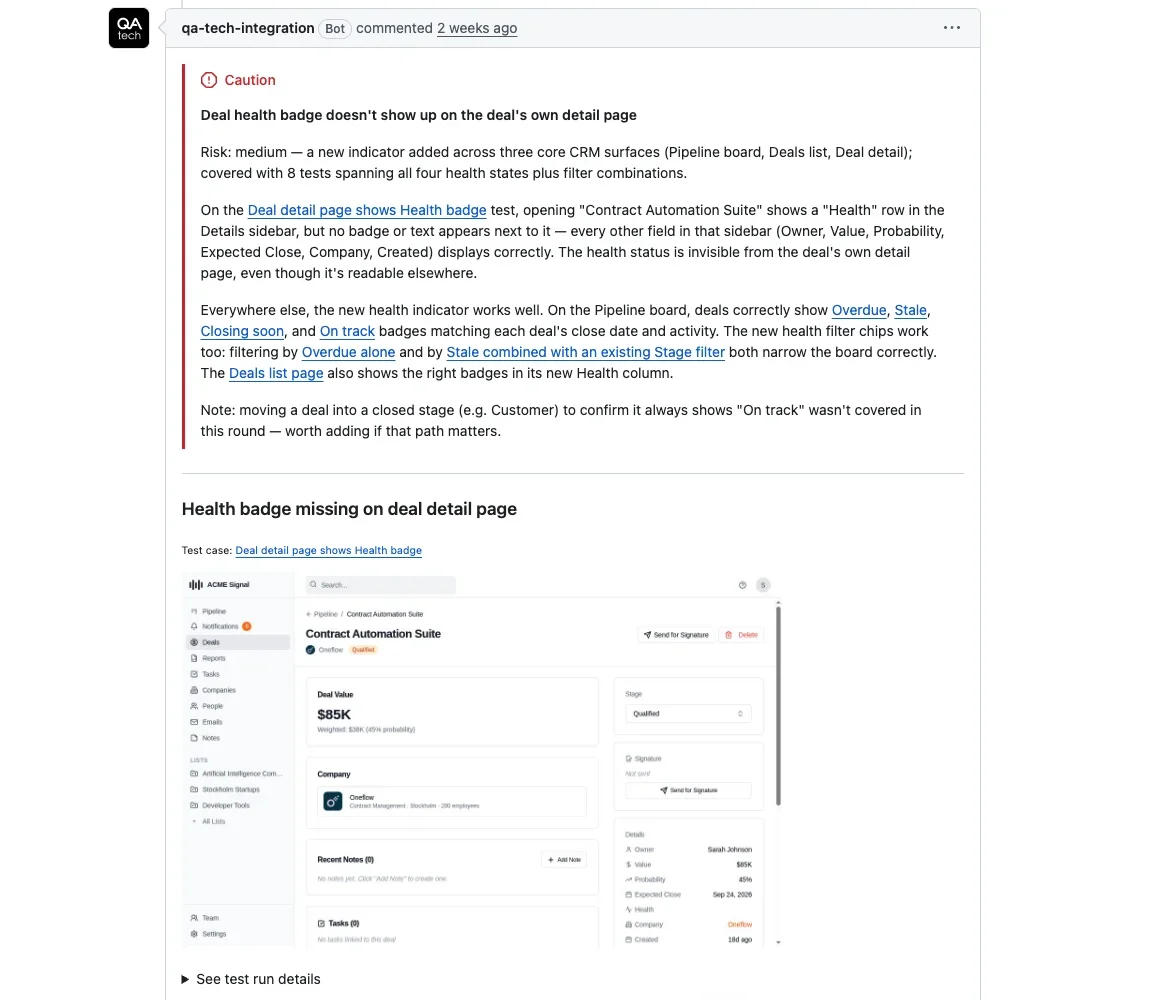
What the review looks like on the PR. This one is from a pull request on our demo CRM: the new health badge worked on the pipeline board and the deals list, and was missing on the deal's own detail page. A diff reviewer had no way to see that.
A pass means the change was exercised and behaved; a run that never reached the change comes back unverified, which is an answer a generated unit test can't give. The QA.tech / PR Review check can be required in branch protection. GitLab merge requests get the same review as a note. Bitbucket, Azure DevOps, Jenkins and CircleCI start it through the API.
Whichever reviewer you land on will still be reading the diff; this is the part that opens the app.
Also in this series: CodeRabbit alternatives, Cursor Bugbot alternatives, GitHub Copilot code review alternatives and Greptile alternatives.