The usual reason to look for a Momentic alternative is the suite. Momentic keeps your tests as YAML files in your repo, lets AI choose which of them run on a pull request, and sends repair pull requests when they break. QA.tech, an AI testing platform, starts from the pull request instead: it reads the change, writes or reuses the test cases that change needs and keeps them out of your repo. Below are six alternatives, compared on the one thing that decides most of these choices: what your team is still maintaining a year from now.
Why teams look past Momentic
Momentic does a lot right. We'd say so even if we didn't compete with it. Its CLI runs tests on your own machine, it covers web, iOS and Android, and its agent, Mo, explores an app and files bugs with recordings. The friction shows up later, in four places:
- The tests are yours to keep. Each test is a
.test.yamlfile. Every product change can mean a change to those files, reviewed by someone. - A PR only runs what already exists. Momentic's pull request guide runs "only the tests that AI test selection picks from the diff". A flow that's new in the PR has no test yet. Someone, usually your coding agent, has to write one into the same PR.
- Healing is a second stream of changes. Auto-heal repairs broken steps and opens a pull request with the fix. That's tidy. It's also a queue of test edits nobody planned, and a wrong repair leaves a test green on a broken product.
- Quarantine hides failures from the check. Quarantined tests "run but do not fail the check by default", per the same guide.
A three-person QA team at a SaaS company told us they'd run a Momentic proof of concept and dropped it, mainly because it wasn't easy enough for a team their size to work with. A news publisher that evaluated Momentic and QA Wolf next to us framed it as setup. They had unit and end-to-end tests already. What they wanted was agent-led testing on top, without building another code-heavy test layer.
1. QA.tech: tests from the change, nothing in your repo
QA.tech's PR testing reviews a pull request the way a tester would. It starts from what the author wrote in the PR and any ticket it links to, then looks at the files and commits (docs). It reuses the test cases that already cover the affected flows, writes new ones for what the change adds and runs them on the PR's preview deployment. No previews? It can review the merged PR against staging or production and post the verdict back on that PR.
The verdict is Fully Verified, Partially Verified, Bugs Found or Can't Verify, posted as a review comment, and on GitHub the QA.tech / PR Review check can be made required before merge (GitHub docs). Tests are written as goals and expected results, and the agent works out the clicks each run, so a moved button doesn't produce a repair to review. When a reviewed PR merges, a post-merge agent can promote the tests it needed into your regression suite. Web runs in a Chromium-based browser, and mobile on simulators and emulators. There's a free trial, and Starter is $89 a month (pricing, checked 25 Nov 2026).
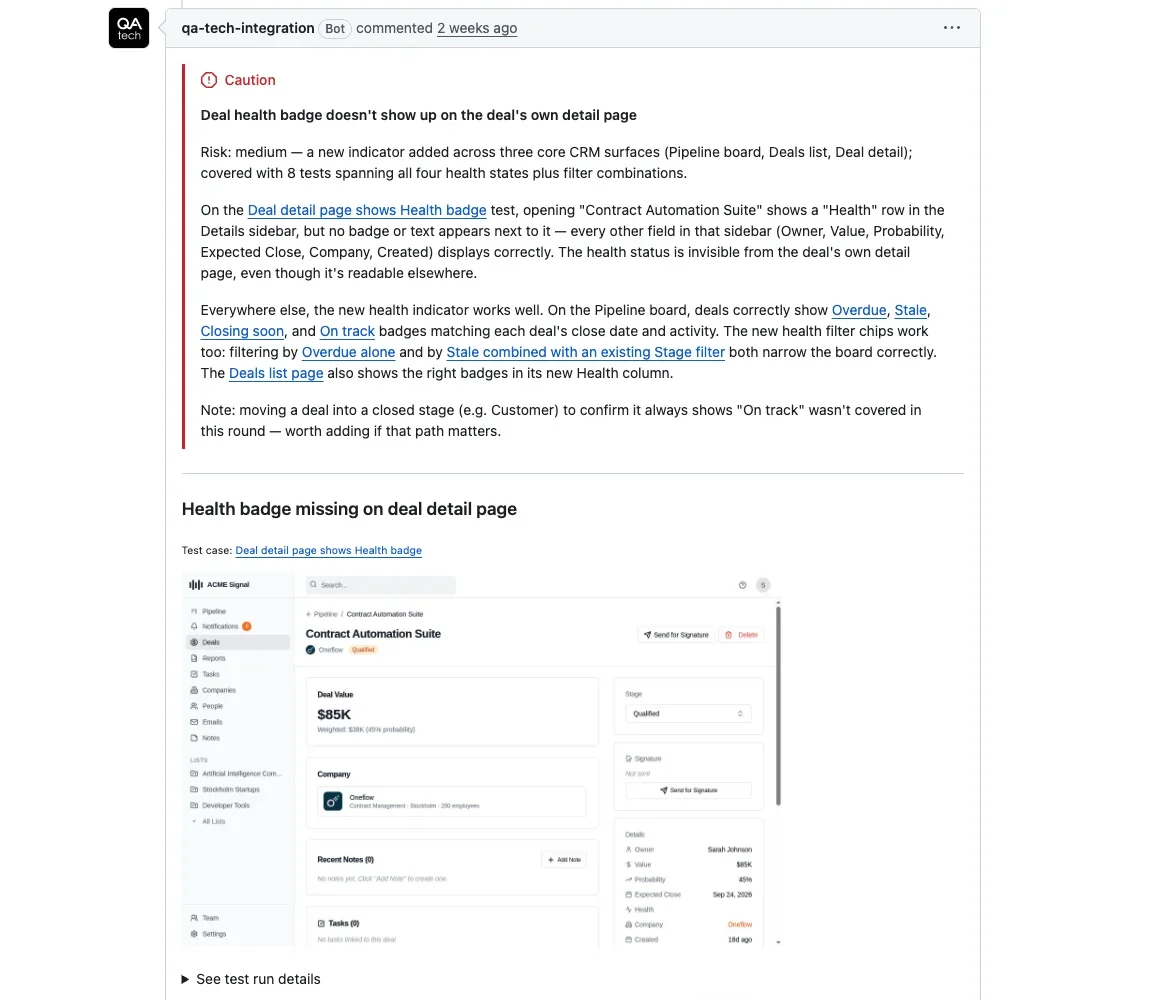
From pull request #46 of our demo CRM: eight tests the agent chose and wrote from the diff, with no YAML file behind any of them. The failure (a health badge missing on the deal page) arrived with a screenshot, ready for whoever owns the PR.
For a side-by-side on every point above, see QA.tech vs Momentic.
2. QA Wolf: a Playwright suite someone else owns
QA Wolf writes your tests "in open-source Playwright and Appium", and on pull requests its "Smart Smoke Suites" pick the tests each change needs. Results post as a GitHub check you can require (PR testing docs).
You end up with a Playwright suite, maintained by QA Wolf's agents and, on its full-service plans, its people. If what you want is quality to stop being your team's job, that's a real offer. But the selection still comes from a suite built ahead of time.
3. Autosana: plain-language flows, built mobile-first
Autosana runs end-to-end tests on iOS, Android and web from flows written as a sentence, stored as .flow.yaml files in your repo. The flows a change touches run on the PR's build, and your coding agent can run them locally through a CLI or MCP before it opens the PR.
Fewer selectors than Momentic. Same model, though: flow files that live in your repository. Its sandboxes for coding agents are in public beta.
4. mabl: low-code testing across web, mobile and API
mabl is a low-code platform whose agents "continuously validate customer experiences across web, mobile, and APIs". Pricing is by quote.
You'd be building a suite in mabl's editor, run on schedules and in CI. For a QA team that wants one broad scripted platform, it's a mature choice. Per-PR testing scoped to the change is a smaller part of the product.
5. TestSprite: an independent agent on every PR
TestSprite waits for a PR's preview deployment, tests that URL and comments pass, fail and blocked results with a fix prompt for your coding agent. A required check makes merges wait for green.
Less to maintain than a YAML suite, as far as we can tell. Less documented, too. The PR page doesn't explain how tests are chosen for a given change, so bring a risky PR and a trivial one to the trial and compare the runs.
6. Playwright test agents: free, in code, and yours
Playwright ships three test agents: a planner that writes a Markdown test plan, a generator that turns it into Playwright tests, and a healer that repairs failing ones. Run them from Claude Code, Codex or VS Code and you have most of what an AI test generator sells, at no cost. We wrote up where Playwright's test agents stop.
What you're left with: a Playwright suite in your repo, generated by the same coding agent that writes your features. If that agent misread the ticket, the feature and its test share the mistake, and the test passes.
Momentic alternatives at a glance
| Tool | Tests on a pull request | Where the tests live | When a test breaks |
|---|---|---|---|
| QA.tech | Picks existing test cases and writes new ones from the change | In QA.tech, no files in your repo | The agent works from the goal; runs it can't complete return Can't Verify |
| QA Wolf | Agents pick from your Playwright suite | Playwright and Appium code | QA Wolf's agents and team repair it |
| Autosana | Flows the change touches run on the PR build | .flow.yaml files in your repo | Not documented on the product page |
| mabl | Your mabl tests, triggered from CI | In mabl | mabl's maintenance features repair it |
| TestSprite | Tests the PR's preview URL | In TestSprite | Not documented on the PR page |
| Playwright test agents | Whatever your agent generates or your workflow runs | .spec.ts files in your repo | The healer agent patches it |
| Momentic | AI picks from your YAML suite | .test.yaml files in your repo | Auto-heal opens a repair PR |
All tool details checked on the vendors' own pages on 25 November 2026. Also in this series: Playwright alternatives, Cypress alternatives, TestSprite alternatives and the best pull request testing tools.
FAQ
What is the best alternative to Momentic? If you want each pull request tested on what it changed without keeping a test suite in your repo, QA.tech. If you want a managed team to own a Playwright suite for you, QA Wolf. If you're mobile-first and like flows written in one sentence, Autosana. If you want to stay in code, Playwright's own test agents are free.
Why do teams look for Momentic alternatives? Usually because of what the suite turns into. Momentic tests are YAML files in your repo, AI picks which of them run on a pull request, and auto-heal sends repair pull requests. Teams that want fewer test files to review, or want brand-new flows tested on the PR that introduces them, look elsewhere.
Is there a Momentic alternative with no test code to maintain? QA.tech keeps no test files in your repo. Its agent reads each pull request, reuses the test cases it already has and writes new ones for the change, then keeps them on its side. Autosana also uses plain-language flows, stored as YAML files in your repo.
Does QA.tech work with GitHub pull requests like Momentic?
Yes. QA.tech's GitHub App reviews a PR when it opens or updates, or when someone comments @qa.tech, and its check can be required in branch protection. It can also review a merged PR against staging when there's no preview.
What are QA.tech's limits compared with Momentic? QA.tech doesn't put tests in your repo, so there's no code to export, and local runs go through a tunnel instead of a CLI on your machine. Web runs in a Chromium-based browser, and mobile runs on simulators and emulators.