QA.tech and Momentic both put an AI agent between a pull request and the merge button, and both run on web, iOS and Android. The split is in where the tests come from. QA.tech, an AI testing platform, reads each pull request and writes or picks the tests that change needs, then keeps them on its side. Momentic runs a test suite you own as YAML files in your repo, with AI picking which of those tests a PR should run and AI repairing them when they break.
Verdict (checked 25 Nov 2026)
Choose QA.tech if you want each pull request tested on what it changed, including flows nobody has written a test for yet, with a verdict that can say "couldn't verify" and a check you can require before merge. It suits teams whose coding agents open more PRs than anyone wants to write tests for, and it has a free trial and a Starter plan at $89 a month (pricing, checked 25 Nov 2026).
Momentic fits a team that wants its tests as files in the repo, runs them from a CLI on its own machines, and has people or agents ready to review the YAML, the heal PRs and the quarantine list.
What Momentic is
Momentic describes itself as an AI QA platform that "explores your web, iOS and Android apps to find bugs, then writes, runs and maintains the tests that catch them" (homepage). In practice there are three parts:
- Tests as YAML. Steps and assertions live in
.test.yamlfiles in your repo, with AI actions for goal-style steps. You run them with a CLI on your own machines, in CI, or on Momentic-hosted browsers, iOS simulators and Android emulators. - Mo, the agent. Mo bug-bashes an app from a URL or a mobile build, files findings with repro steps and recordings, and turns a flow you approve into a Momentic test by opening a pull request in your repo.
- AI maintenance. Auto-heal and failure recovery repair broken steps. Momentic's homepage counts 154,400 "failures prevented by AI recovery".
Momentic names Notion, Quora and Webflow as customers. It's a serious product, and a lot of what it does well is the developer loop around a scripted suite.
Where QA.tech and Momentic differ
Which tests run on a pull request
Momentic's pull request guide runs "only the tests that AI test selection picks from the diff", against the PR's preview deployment. If the change adds a flow with no test yet, the guide's answer is to have your coding agent write one with Momentic's spec skill, so the new YAML lands in the same PR.
QA.tech doesn't need the test to exist first. The agent reads the PR description, any linked Jira or Linear ticket, the changed files and the commits, maps the change to user flows, reuses the test cases that already cover them and writes new ones for the gaps (PR testing docs). The depth follows the risk: a change near sign-up or payments gets a closer look than a copy fix.
That matters most when the code is written by agents. The same agent writing the feature and its own test is the setup Vilhelm von Ehrenheim, our co-founder and Chief AI Officer, warns about: "there's still a huge risk for bias," he told a CTO audience in September, so you want verification "that is not controlled by the agent loop itself."
What a green check means
On Momentic, a failed CI run exits non-zero and can block the merge. Quarantined tests are the exception: per the same guide, they "run but do not fail the check by default." So green can mean "everything that counted passed", with the flaky ones set aside.
QA.tech's check, QA.tech / PR Review, finishes as Fully Verified, Partially Verified, Bugs Found or Can't Verify (GitHub docs). You can require it in branch protection. The point of the extra states is that a run which couldn't reach the change says so, instead of passing quietly.
Healing, or tests that work from the goal
Momentic leans on healing. Locators heal, failures recover, and permanent repairs come back as a pull request against your YAML for someone to approve. It's a sensible design for a scripted suite. It's also a stream of test changes that someone has to read, and a repair that guesses wrong leaves a test green while the product is broken. We've written about why self-healing is a misleading frame.
A QA.tech test case is written as a goal, the steps toward it and the expected result. The agent figures out how to get there on the live app every time it runs, so a button that moved or got renamed doesn't break anything and doesn't generate a repair to review. Where a journey must never vary, you pin the exact labels and order as checks.
What you maintain afterwards
With Momentic you own a test suite: YAML in the repo, heal PRs, a quarantine list, and the CI workflows that run them. One upside is portability, because the files are yours. A three-person QA team at a SaaS company that ran a Momentic proof of concept before talking to us gave the other side of that: they dropped it, mainly because it wasn't easy enough for a team their size to work with.
With QA.tech there are no test files in your repo. The test cases a review needed stay available to later PRs, and after merge a post-merge agent can promote them into your regression suite, labelled regression and auto-added. Scheduled test plans run that suite and alert Slack, email or Teams when it fails.
Previews, or after merge
Both tools test the PR's preview deployment. Without previews, Momentic's guide moves you to a regression pass on staging after merge. QA.tech can review the merged pull request itself against staging or production and post the verdict back on that PR, so the result still lands where the change was discussed. One engineer we spoke to asked exactly this: "Does this only work if you have previews as part of PRs?" His team merges straight to staging. The after-merge review is for that setup.
Running locally
Momentic is strong here. Its CLI runs tests on your own machine against a local app, and a marketplace startup's QA lead who trialled both told us she'd choose on "whichever one handles the local runs in the simplest way." QA.tech reaches a local app through a tunnel, and its initial crawl isn't meant to run against a laptop. If local-first is the deciding factor, weigh that.
QA.tech vs Momentic at a glance
| Tests on a PR | Where tests live | When a test breaks | Without a preview | Mobile (checked 25 Nov 2026) | |
|---|---|---|---|---|---|
| Momentic | AI picks from your existing YAML suite; your coding agent writes new tests into the PR | .test.yaml files in your repo | Auto-heal repairs it and opens a PR; quarantined tests don't fail the check by default | Regression pass on staging after merge | iOS simulators, Android emulators |
| QA.tech | Picks existing test cases and writes new ones for the change | In QA.tech, no files in your repo | The agent works from the goal; runs it can't complete return Can't Verify | Review of the merged PR against staging or production | iOS Simulator and Android Emulator builds from CI |
How QA.tech tests a pull request
The GitHub App reviews a pull request each time it's opened or updated. You can also comment @qa.tech, with instructions if you want to steer it. PRs that don't touch anything a user sees, such as docs-only or CI-only changes, get a skipped check with the reason. Everything else gets a review comment with the risk level, what was tested, a results table and the verdict, and every test carries its own screenshots, console and network logs, and a trace of what the agent did.
It won't review your code, it isn't a load or security testing tool, and web tests run in a Chromium-based browser. What it removes is the job of writing and repairing a test for every change your team ships.
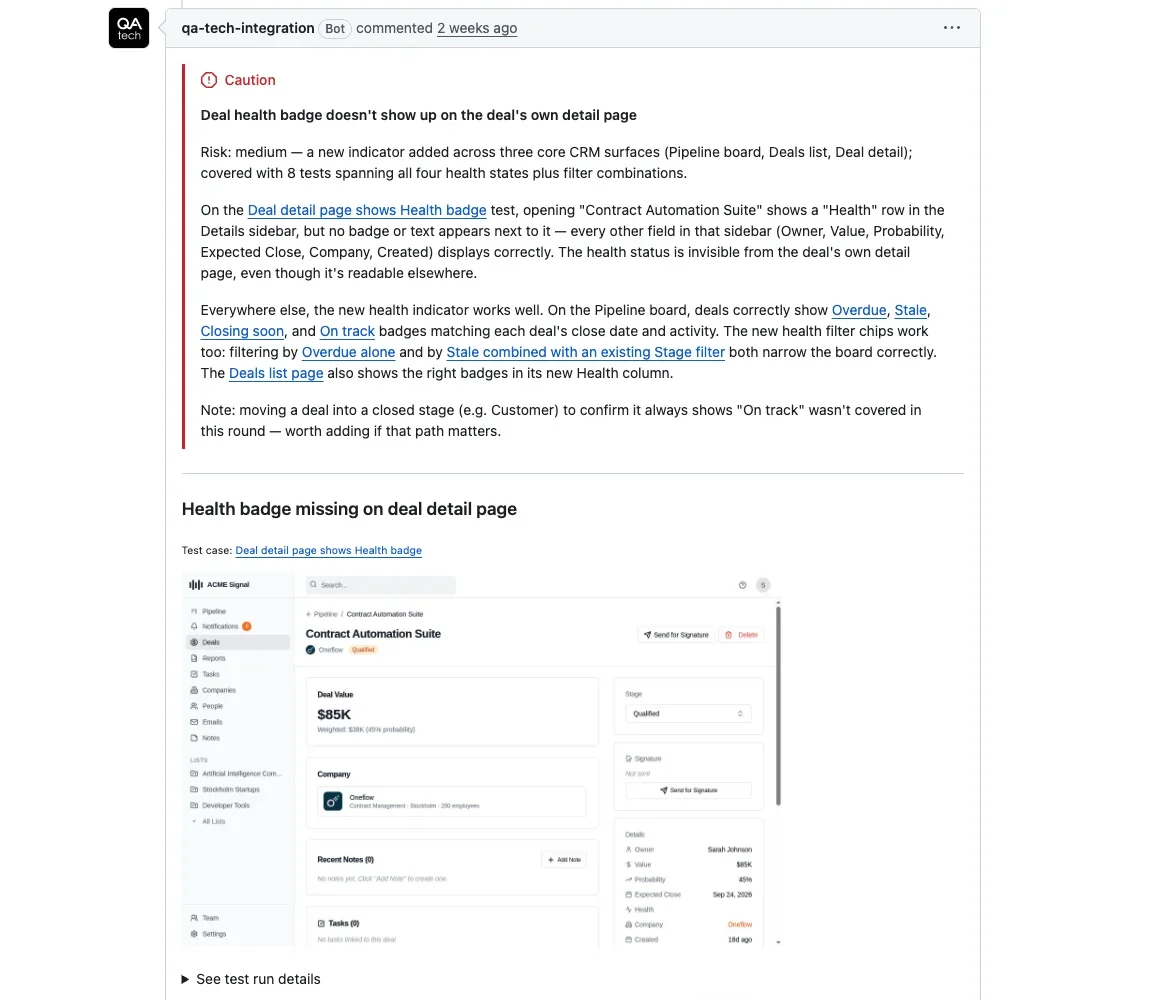
From PR #46 in our demo CRM repo. None of the eight tests came from a YAML file: the agent picked and wrote them from the diff, and the one failure (a health badge missing from the deal page) came with a screenshot.
Looking at more than these two? Our Momentic alternatives page covers the wider field, and the best pull request testing tools compares every tool that runs your app on a PR.
FAQ
What is Momentic? Momentic is an AI testing platform for web, iOS and Android. Tests are YAML files in your repo with AI steps and assertions, run from a CLI locally, in CI or on Momentic's hosted browsers and devices. Its agent, Mo, explores an app, files bugs and opens pull requests that add approved flows as tests.
How does Momentic test pull requests? Through a CI job. Momentic's guide runs the tests its AI test selection picks from the diff against the PR's preview deployment, and a failed run fails the job, which you can make a required check. New tests for the change are written by your coding agent into the same pull request.
What is the main difference between QA.tech and Momentic? Where the tests come from and who keeps them. Momentic selects from a YAML suite that lives in your repository and that your team or agents maintain. QA.tech reads each pull request, picks the test cases it already has, writes new ones for whatever the change touches and keeps them on its side, with no test files in your repo.
Does Momentic have self-healing tests? Yes. Momentic's auto-heal and failure recovery repair locators and steps, and repairs arrive as a pull request to review. QA.tech's agent works from the test's goal on every run, so a moved button doesn't need a repair, and a run it couldn't complete is reported as such.
Can I try QA.tech before buying? Yes. QA.tech has a free trial that includes PR testing on one application, and Starter at $89 a month covers small teams (pricing, checked 25 Nov 2026). Growth and Enterprise are priced to your volume.
Can I run Momentic and QA.tech together? Yes. Some teams keep a small scripted suite for the flows that must never break and add QA.tech for each pull request. Each tool reports its own result on the PR.
What doesn't QA.tech do? It doesn't write test files into your repo, so there's nothing to export as code. Web tests run in a Chromium-based browser, native apps are tested on iOS Simulator and Android Emulator builds (physical devices are on the docs' coming-soon list), and only GitHub gets the merge-blocking check.