
It seems like the role of a QA engineer is following the same path as a lot of legacy tech jobs. The reason for this is not because quality matters any less. If anything, it matters more than ever.
As teams are now shipping code faster due to increased AI use, the traditional methods of QA built around performing repetitive regression tests, creating release checklist items, and conducting manual verifications have proven insufficient.
It’s clear quality-related work will remain necessary. However, the way it’s been approached traditionally no longer works.
Simply Put
For years, the role of a manual regression tester was a core part of how teams shipped software. This role (or, at least, its traditional form) is slowly fading out.
It's not that manual testers aren't doing a good job. Most of them are diligent, precise, and skilled professionals, but the kind of work they used to focus on (the execution of test cases, for example) is being rapidly automated. For many, there just isn’t enough time to adapt to the tools that are already here.
At this point, we can safely say it’s no longer a “maybe someday” scenario. The future is already here. Teams that had eight manual testers just a couple of years ago are now able to operate successfully with a much smaller QA staff because they are using better tools and more efficient operational models.
Take Pricer, for example. They went from eight testers to two, introduced agentic testing, and actually saw an increase in test coverage. Upsales tells a similar story – it replaced 320 hours of manual testing with AI agents.
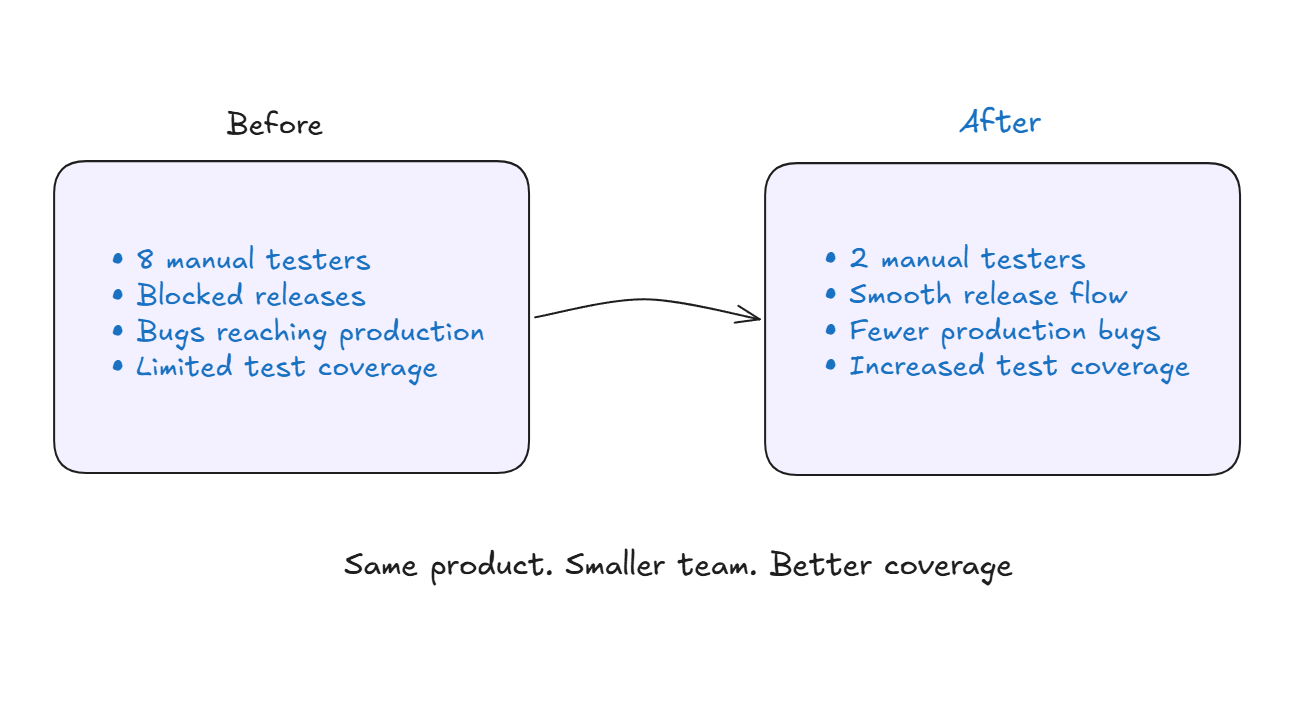
Pricer reduced its QA team from 8 to 2 while increasing test coverage after switching to agentic testing
If you’re a manual tester reading this post, don’t worry. I’m not here to scare you. My goal is to give you a clear idea of what you’re facing and help you figure out what to do next.
What’s Actually Going Away
When people say that manual testing is dead, they’re just talking about the repetitive aspect of the job, not the human brain behind it.
Think about the last sprint you participated in. How much time did you spend clicking through the same log-in flows (for the 50th time) and running the same smoke tests? Or even just updating a Jira ticket to indicate that you had “passed”?
Human testers were required for this kind of work in the past because legacy automation tools, such as Selenium or Playwright, were so fragile. If a developer changed a CSS class, it would break the entire automated test suite for the application. Then, it would take the whole day to fix all of the automated script files.
AI agents have completely changed the game. Our ebook Past the Bottleneck shows what QA looks like once that shift is complete. They don’t get tired, they don’t miss a step because they haven’t had their coffee yet, and most importantly, they can detect and adapt to changes in the UI without requiring a human tester to rewrite test scripts.
So yes, this repetitive layer of the job is gone. And honestly, most of the manual testers I’ve spoken to aren’t really upset about it. They’re just worried about what comes next.
What’s Not Going Away
Just because AI agents are skilled at handling your repetitive testing work doesn’t mean they’re good at every task you throw at them. There are still real limitations that are unlikely to disappear anytime soon.
For example, an AI agent won’t tell you that most enterprise users copy-paste billing addresses from old emails, accidentally adding trailing spaces that cause invoices to quietly fail (even though they technically pass validation). It also won’t notice that users keep multiple browser tabs open and jump between forms out of order. And, it can’t possibly develop that instinctive sense that something is off, like when the invoice passes through the electronic validating process, but is still wrong based on the behavior of the user. That’s where human value resides.
To sum it up, here’s what YOU bring to the table:
-
Product knowledge: You already know which parts of the app usually break, which screens cause problems again and again, and where old fixes are still somehow holding things together. Agents are starting to build this kind of memory too, but yours comes with business context and user empathy that no knowledge base has just yet.
-
That “something feels wrong” instinct**:** Sometimes everything works, but it just doesn’t feel right. Like, the page feels slow, or a button looks just a bit off. AI is getting better at catching performance signals but determining if the page feels good to the end-user is still your call.
-
Business context: Unlike AI agents, you know that some releases are riskier than others. This kind of judgement is still largely human, but it’s changing fast.
The idea that manual QA is obsolete gets thrown around a lot, but what’s actually obsolete is the execution layer. What has changed is how you as QA analysts measure and demonstrate your value, rather than depending on test execution as the primary proof of it.
The future of manual QA testing isn’t just about running fewer tests. It’s also about thinking critically and determining which tests should be prioritized based on a defined set of requirements.
Three Career Paths Moving Forward
If you are thinking about your own career as a manual tester and what all this means for you, here are three paths worth considering:
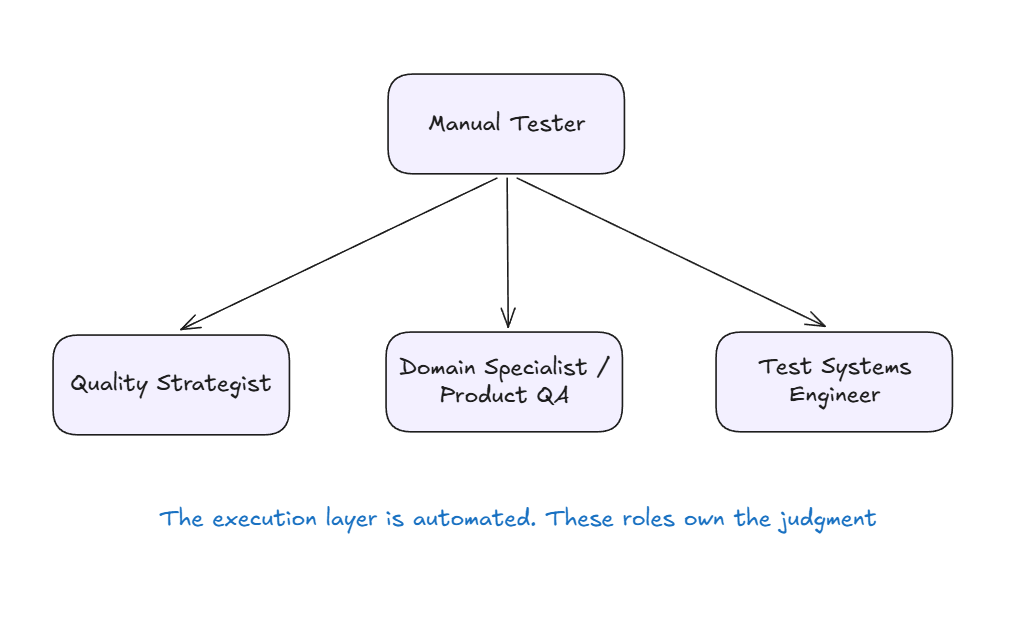
Three realistic career paths for manual testers navigating the shift to AI-powered QA
Quality Strategist
Instead of running tests, you become the person who decides what needs to be tested and why. You review what the agents are doing, find gaps in testing results, and decide whether any additional testing is required to ensure the client will receive a functioning product. You stop being the hands-on executor and start being the architect.
On paper, this role doesn’t look too different from a QA lead, as you may still be focused on coverage and risks. However, your day-to-day tasks will change completely.
Domain Specialist / Product QA
This path is for testers who love exploratory side of QA. You’ll be focusing more on the user experience and edge cases, thinking about how real users may break things and finding those strange, non-linear bugs that other testers may overlook. Instead of just going through the UI developments, you’ll be delving into the product’s logic in greater depth.
Techniques like exploratory testing, accessibility testing, usability testing, and edge case testing will always be valued for the depth of insight they bring, not for the sheer number of tests that have been performed.
So, if you’re transitioning from the manual tester role and enjoy exploratory testing (like finding bugs or using intent), this path is definitely worth considering.
Test Systems Engineer
If you’re interested in the tech side of QA, this may be a good fit. Your responsibilities will go beyond writing test scripts. You will also be in charge of managing the entire infrastructure. This includes overseeing the CI/CD pipelines, defining how agents interact within your development environment, and improving the feedback loop and how it works from the moment when a bug has been identified to when it has been fixed by the developer.
There’s currently a great demand for test systems engineers. If you’re an automation engineer or a tester who possesses the knowledge of CI/CD and understand the causes of test variability, you’re likely already closer to this kind of role than you might think.
What to Learn Now
My honest advice is not to focus on learning automation tools like Selenium or Playwright or spending a lot of time writing test scripts. At this point, it can feel a bit like learning how to build a horse and buggy just as Model T is coming off the assembly line. Basically, you’d be going in the same direction as the automation agents that have already mastered the process.
Instead, I would recommend focusing on:
-
Writing clear “test intent”: Learn how to describe in natural language what you want the agent to test and what outcome you expect.
-
CI/CD basics: Master how GitHub Actions or GitLab Pipelines work and figure out where your tests fit in the dev process.
-
Data literacy: Figure out how to interpret all the AI-generated test data and identify trends. If there are ten failed tests, are they all actual bugs, or is there an issue with the server?
-
Prompt engineering: While this is a buzzword to an extent, it will save you a great deal of time in being able to communicate with agents and having them test for a specific edge case.
These skills work across every agentic testing tool, not just one platform. As such, they will be relevant regardless of what the tooling landscape looks like in two years.
Wrap-up
The career of a manual tester might be on its way out, but those who have held it certainly aren’t. History has demonstrated that roles rarely disappear; they simply evolve. When compilers first came along, there was no longer a need for people to write machine code by hand. But that doesn’t mean they lost their jobs. They just became software engineers.
Now, we are undergoing a similar transition in the QA industry. Instead of just running tests, we are being asked to think about what testing should mean in the first place.
If you’re ready to stop doing repetitive tasks and start focusing on true quality, it is time to redefine how you do your job. For a deeper look at where your role is headed, read about what skills QA engineers will need in 2026 and how teams are restructuring QA for the AI era.
Want to see first-hand how AI can do the hard work for you? Book a demo with QA.tech today and find out how QA agents will improve your team’s ability to create software and deliver products faster.
Related reading
- From Manual to Autonomous QA: Step-by-Step Guide
- Manual, Automated & AI Testing – Choose the Right Approach
For engineering leaders rethinking the QA function, the shift is from writing tests to directing agents that write them.